



Blog | GARAGE DOORS
Heating & Cooling a Converted Garage: What Works Best for Year-Round Comfort
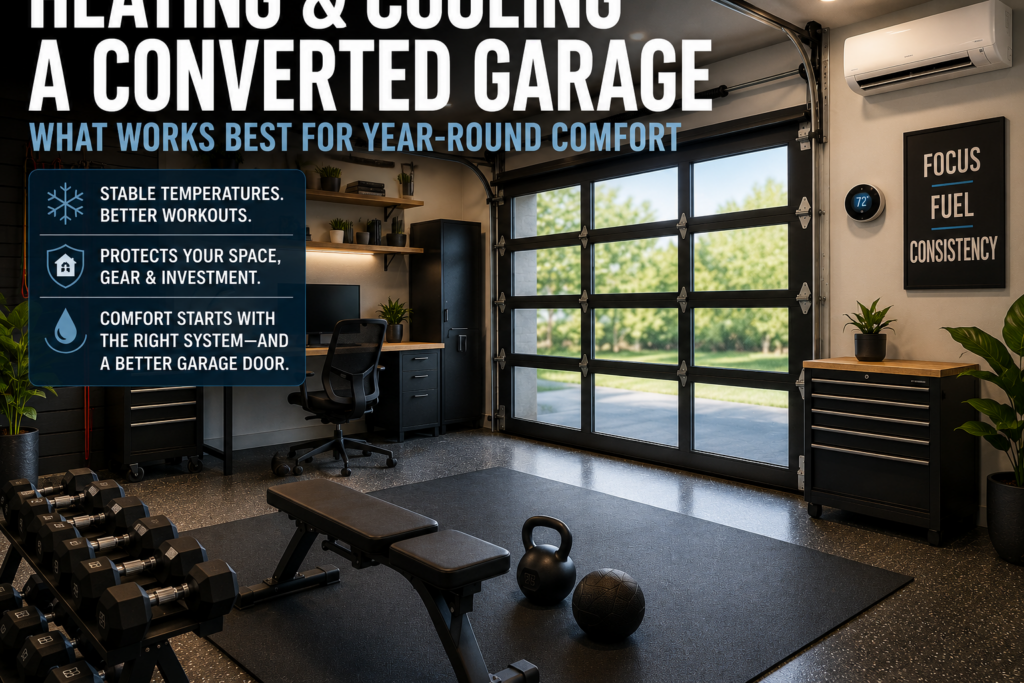
Insulation makes a garage possible to use year-round. Heating and cooling make it comfortable.
Once homeowners convert a garage into a gym, office, studio, or hybrid gathering space, the next realization usually comes fast:
Even insulated, the garage doesn’t regulate temperature like the rest of the house.
That’s because garages were never designed to be conditioned spaces. They lack ductwork, often sit on uninsulated slabs, and experience frequent door openings that destabilize interior air.
The good news? There are effective solutions to change all of that.
The key is choosing the right system for how the space will be used, without overspending or creating new moisture problems.
Below is a clear breakdown of heating and cooling options, including cost ranges, tradeoffs, real-world outcomes, and where most homeowners make mistakes.
Step One: Define the Comfort Goal
Before choosing equipment, clarify your objective:
Are you trying to:
- Make winter workouts tolerable?
- Maintain stable temperatures year-round?
- Protect tools and electronics?
- Support a true home office environment?
- Reduce humidity?
Your goal determines your system.
Option 1: Ductless Mini-Split Systems
The Most Complete Solution
Mini-split systems are currently the gold standard for conditioned garage conversions.
They consist of:
- An indoor air handler
- An outdoor condenser
- Refrigerant lines connecting the two
They provide both heating and cooling.
Mini Split Cost
- Installed cost: $2,000–$6,000
- Higher-capacity or multi-zone systems: $4,000–$8,000
Factors that affect the price:
- Garage size
- Electrical upgrades
- Brand selection
- Installation complexity
Real-World Performance
Mini-splits:
- Maintain stable comfort year-round
- Perform well in insulated garages
- Operate quietly enough for office use
- Improve resale value perception
In fully converted garages, this is often the most satisfying long-term solution.
Pros
- Efficient heating and cooling
- Precise temperature control
- Quiet operation
- Energy efficient (high SEER ratings)
- No ductwork required
Cons
- More expensive upfront
- Installation-sensitive
- Dependent on insulation and door performance
- Visible inside the space
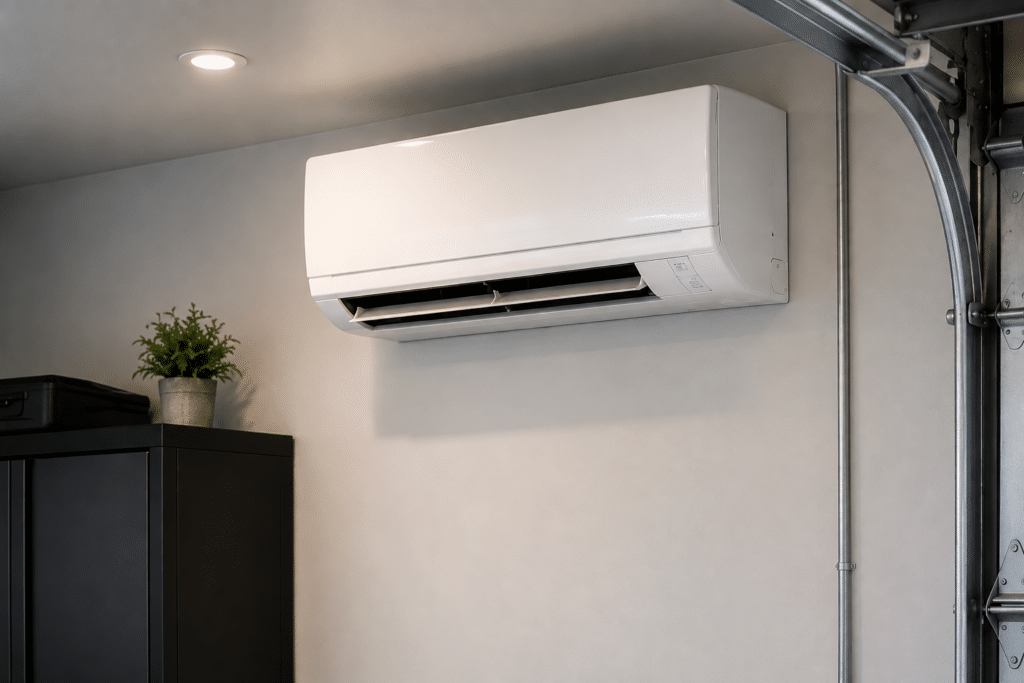
 A1 Pro Insight: Mini Split Oversizing Is a Common Mistake
Many homeowners install systems that are too large for the space. This causes short cycling—where the unit turns on and off rapidly—reducing efficiency and humidity control. Proper load calculation matters more than raw BTU size.
Option 2: Electric Garage Heaters
Targeted Winter Comfort
If your primary concern is cold weather, electric heaters can be effective.
Common types of electric heaters for the garage:
- Ceiling-mounted forced air units
- Infrared panel heaters
- Portable electric heaters
Cost
- Portable heaters: $100–$400
- Ceiling-mounted installed units: $500–$2,000
Pros
- Lower upfront cost
- Quick heat
- Simple installation
Cons (Problems)
- No cooling capability
- Higher electricity usage
- Can create dry air
- Limited whole-room distribution
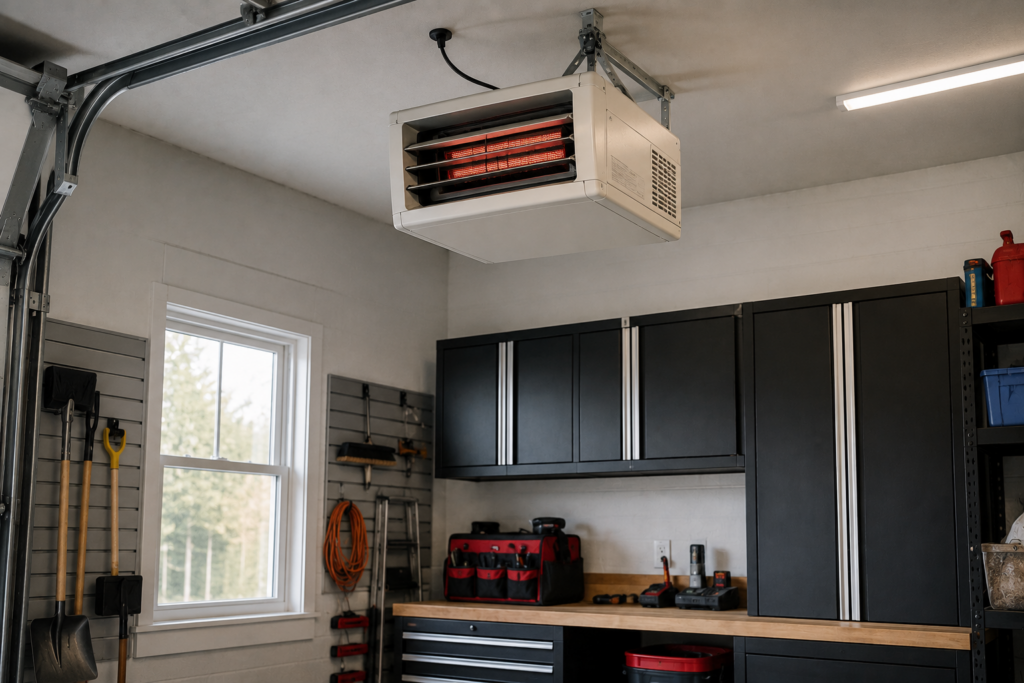
A1 Pro Insight: Infrared vs Forced Air
Infrared heaters warm objects directly. They are great for workbenches or workout areas. Forced air heats the room volume. Choosing the wrong style, however, can leave you warm in one spot but cold elsewhere.
Best For:
- Winter-only use
- Detached garages
- Budget-conscious upgrades
- Workshops
Option 3: Portable Air Conditioners
Limited Cooling on a Budget
Portable AC units are often seen as an easy solution.
Cost
- $300–$800 for mid-grade units
Pros
- Plug-and-play
- No permanent installation
- Lower upfront cost
Cons
- Loud operation
- Limited cooling power
- Requires window or vent access
- Poor humidity control in larger spaces
A1 Pro Insight: Portable Units Struggle in Poorly Insulated Garages
If the garage door is uninsulated or air leaks exist, portable AC units often run continuously without achieving stable comfort. Cooling equipment cannot compensate for poor envelope performance.
Option 4: Extending Existing HVAC Ductwork
Usually Not Recommended
Some homeowners consider tying the garage into their home’s central HVAC system.
Cost
- $1,000–$3,000 depending on complexity
Problems & Drawbacks:
- Often violates building codes
- Can create negative pressure issues
- Risks carbon monoxide contamination in attached garages
- Overloads home HVAC system
A1 Pro Insight: Most HVAC Pros Advise Against Extending Existing HVAC
Garages are classified differently from living spaces. Tying into existing ductwork can create safety and efficiency issues. A dedicated system is usually safer and more effective.
Don’t Forget Humidity Control
Temperature is only half the equation. In humid climates, garages can experience:
- Condensation on slabs
- Rusted tools
- Mold growth
- Warped flooring
Dehumidifiers
Cost
- $200–$1,000 depending on capacity
They:
- Reduce moisture
- Protect flooring and hardware
- Improve comfort
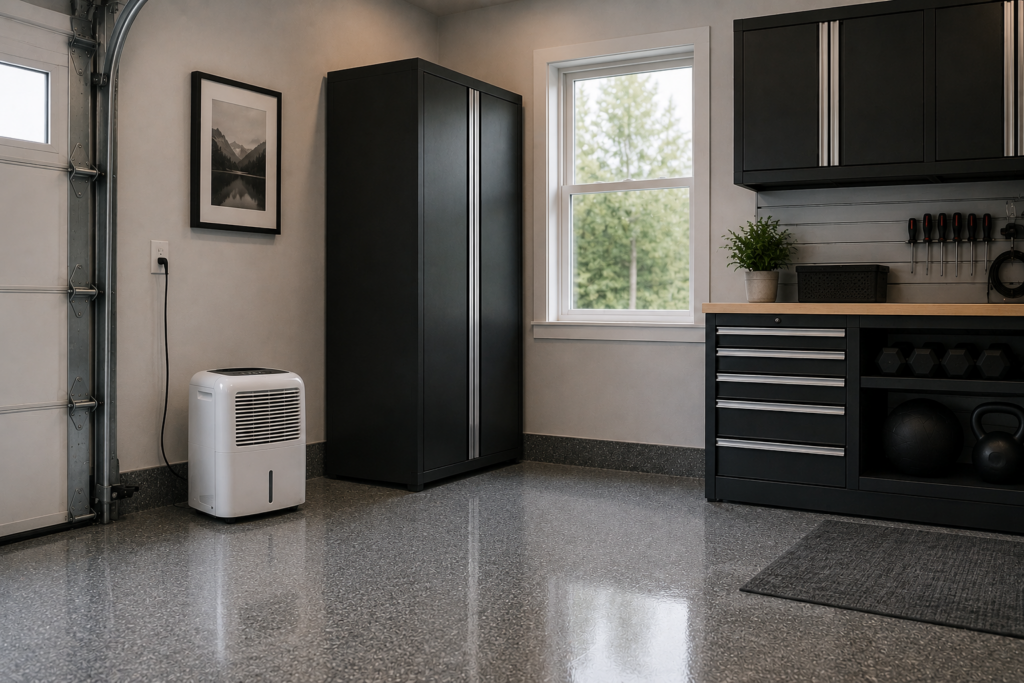
A1 Pro Insight: Climate Stability Protects Your Investment
Floor coatings, storage systems, and garage doors all last longer in stable environments. Heating and cooling is not just about comfort—it protects materials.
How the Garage Door Impacts Heating & Cooling
Here’s what many homeowners overlook: Every time the garage door opens, conditioned air escapes.
If the garage door is:
- Thin steel
- Poorly sealed
- Non-insulated
- Lacking bottom weatherstripping
Your HVAC system must work harder.
A1 Pro Insight: The Garage Door Is the Largest Thermal Variable
Upgrading to an insulated garage door (R-12 to R-18+) dramatically reduces energy loss. It also stabilizes interior temperatures between cycles of use.
When paired with:
- Proper side and top weatherstripping
- Bottom seal replacement
- Threshold sealing
Comfort improves significantly—even before installing HVAC equipment.
Energy Use & Operating Costs
Estimated Monthly Operating Costs of Potential Systems:
- Mini-split system: $30–$100 depending on usage and climate
- Electric heater (winter use): $50–$150
- Portable AC: $40–$120
Actual costs depend on:
- Insulation quality
- Door performance
- Frequency of use
- Local utility rates
What Doesn’t Work
- Heating an Uninsulated Garage
Energy bills skyrocket, comfort remains inconsistent.
- Ignoring Air Sealing
Conditioned air escapes through cracks and door gaps.
- Choosing Equipment Before Fixing the Envelope
Insulation and sealing come first. HVAC comes second.
Best-For Recommendations
Light, Occasional Winter Use
- Electric heater + basic air sealing
Gym or Hobby Space (Moderate Use)
- Mini-split + insulated garage door
Full Office Conversion
- Mini-split
- Insulated door
- Ceiling insulation
- Dehumidifier (if humid climate)
Detached Garage Workshop
- Electric heater + ventilation
- Possibly portable AC for summer
The Bigger Picture: Comfort Enables Habit
A garage that’s too hot in summer or too cold in winter becomes seasonal.
Seasonal spaces get used inconsistently.
Inconsistent spaces fail to support new habits—whether fitness, focus, or creativity.
Heating and cooling, when done properly, make the garage reliable.
And reliability is what transforms a converted garage from an experiment into part of daily life.
Just like flooring and insulation, climate control works best when the entire system supports it.
The garage door is not separate from this conversation—it is the largest moving wall in the room.
When sealed, insulated, and paired with the right heating and cooling solution, the garage stops reacting to the weather.
It starts performing for how you live.