



Blog | GARAGE DOORS
Garage Door Rollers: Nylon vs Metal (What to Choose and Why)
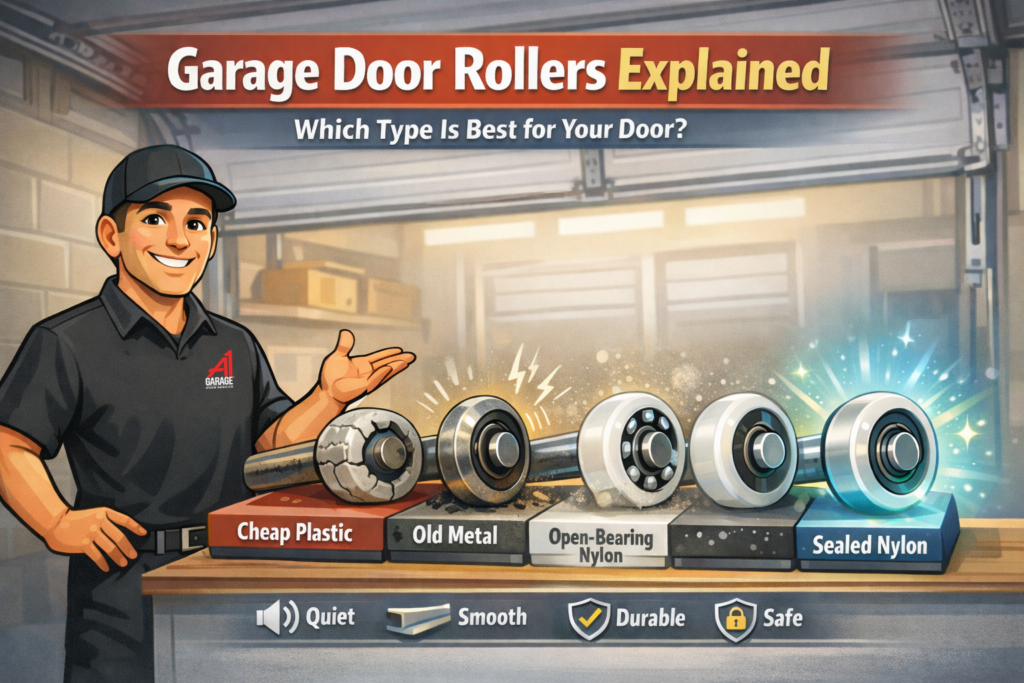
Before we get into the full guide, here are the main answers at a glance
- Not all garage door rollers are the same.
- Cheap plastic or metal rollers often cause noise and wear.
- Nylon rollers are better than old metal rollers for most homes.
- Open-bearing rollers are better than basic rollers, but still need care.
- Sealed bearing rollers are the best long-term option for most homeowners.
- A longer stem roller can improve safety and reduce hinge stress.
- In dusty places such as Phoenix, sealed rollers matter even more.
- If your garage door is loud, rollers may be one of the main reasons.
- A better roller can help prevent cracked hinges, rough movement, and off-track issues.
All garage door rollers are basically the same, aren’t they?
At A1, we meet homeowners every day who have lived their lives believing the myth that all garage door rollers are created equal. They’re not.
The truth is, there are a lot of garage door rollers on the market that are built differently to perform differently, depending on your door and where you live among other key factors.
In this guide, the experts at A1 break down the different types of garage door rollers and explain their value and potential shortcomings. By the end, you’ll know which roller is best for your home’s unique garage door system.
What do garage door rollers actually do?
Garage door rollers help the door stay in the track and move smoothly as it opens and closes. If the roller is poor quality, worn out, or wrong for the door, you may notice:
- Squeaking or grinding
- Rough movement
- Stress on hinges
- Track wear
- More opener strain
- Less safe operation
 A1 Pro Tip:
Rollers are one of the main causes of loud garage door noise, along with bearings and operators.
What do homeowners really want to know about garage door rollers?
-
Problems: What can go wrong with the wrong roller?
A bad garage door roller can create more than just noise.
Cheap plastic wheels can break, wear down, and reduce smooth operation. On the other hand, metal rollers can damage the track over time and may even lead to cracked hinges.
One of the biggest safety concerns is hinge stress. The wrong wheel type can lead to stress fractures on all your hinges. Since those hinges help support the door above your car, those tiny breaks are not a small issue.
A1 Pro Safety Tip:
Some metal rollers can look fine until you remove them. Then, they fall apart, meaning they weren’t very strong before. That is a serious concern on a heavy door.
-
Comparisons: Which roller types are best?
Here is the simple A1-approved ranking from worst to best.
Builder-grade plastic rollers
These are common on newer development homes. They are cheap and basic. They may not even roll well. They can wear down quickly and leave black residue.
Best for: Almost nobody long term
Main downside: Wear, noise, poor performance
Old metal rollers
These are strong, but they are loud. They can also wear into the track over time.
Best for: Limited heavy-duty applications
Main downside: Noise, track wear, harsh operation
Nylon open-bearing rollers
These are a step up. They are quieter and smoother than builder-grade options. But the bearing is still exposed.
Best for: Better than basic rollers
Main downside: Dust and grit can get inside
Nylon-capped rollers
These add a little protection, but not enough to fully solve the problem.
Best for: A modest improvement
Main downside: Still not fully sealed
Sealed-bearing nylon rollers
This is the clear winner as far as we’re concerned at A1. These sealed rollers are rated for 100,000 cycles.
Best for: Most homeowners
Main upside: Quiet, durable, low maintenance
Why sealed rollers matter more in Phoenix
Phoenix-area homeowners deal with dust, dry conditions, and monsoon debris. Open-bearing rollers are more likely to collect dust and grime, which can wear them out faster.
A1 Pro Insight:
The dirt and grit inside an open bearing can turn it into “a rock polisher.” Sealed rollers don’t have that issue and therefore last longer in Arizona.
Cost and pricing: Is the upgrade worth it?
While prices can and will vary, open-faced rollers to premium sealed rollers are more expensive than lesser quality rollers.
That matters because homeowners often focus on the cheapest option. But the better question is this: What costs more over time, a cheaper roller or repeated noise, wear, and future repairs?
If a better roller reduces maintenance, protects hinges, lowers noise, and lasts longer, many homeowners will see that as a smart long-term value.
Best practices: What should homeowners do?
Here are the A1-approved best practices homeowners should adopt concerning garage door rollers:
Choose nylon over metal for most residential doors
Metal rollers may seem stronger, but they are usually louder and harder on the system.
Go with sealed bearings when possible
In a dusty climate, sealed bearings help keep out dirt and reduce wear.
Think about stem length
A longer stem roller can improve safety and reduce hinge stress.
A1 Pro Recommendation:
At A1, we often recommend a seven-inch stem roller because it covers more surface area and is less likely to pop out if the door gets off track.
Do not install rollers yourself
Garage doors are heavy, complicated systems, and roller work can involve risk. Leave the job to trained professionals.
Use the right lubricant
At A1, we strongly warn against using the wrong product, such as WD-40, to lubricate your garage door rollers. Instead, we recommend a garage-door-safe silicone-based lubricant.
DIY vs. Pro: Can you replace garage door rollers yourself?
Jobs that involve garage door rollers lean strongly toward requiring professional help.
That is especially true if:
- Your door is heavy.
- Your hinges are cracked.
- Your track is worn.
- Your door is off balance.
- Your door has come off track before.
For many homeowners, this is not the time and place to experiment with your handy skills. A trained technician can inspect the entire system, not just swap one part.
A hidden benefit: Quieter operation
When it comes to garage doors, many homeowners care first about noise, not safety.
The right rollers can solve both issues for a garage door. On the one hand, they are more durable and therefore safer. On the other hand, they are also more efficient and quieter.
In one minute
Here is the recap:
- All garage door rollers are not equal.
- Cheap plastic rollers wear down fast.
- Old metal rollers are loud and can damage tracks.
- Open-bearing nylon rollers are better, but still exposed.
- Sealed-bearing nylon rollers are the best all-around option.
- Longer stem rollers can improve safety.
- Phoenix dust makes sealed rollers even more important.
- Loud doors often need better rollers, not just more lubricant.
FAQs about Garage Door Rollers
What type of garage door roller is best?
For most homes, a nylon sealed-bearing roller is the best choice because it is quieter, smoother, and lower maintenance.
Are metal garage door rollers better?
Not for most residential doors. They are durable, but usually louder and harder on tracks and hinges.
Why is my garage door so loud?
Worn rollers are a common cause of garage door noise. Bearings, hinges, and the opener can also add to the problem.
How long do premium garage door rollers last?
Sealed rollers are rated for up to 100,000 cycles.
Should I replace garage door rollers myself?
It is safer to have a trained professional handle it, especially on heavy doors or doors with damaged hinges.
If your garage door is loud, shaky, or wearing down parts faster than it should, now is the time for an inspection. The right roller can make a bigger difference than most homeowners expect.
Need help choosing the right garage door rollers for your home? Schedule an inspection with A1 Garage Door Service and let our team help you find the safest and quietest option for your door.