



Blog | GARAGE DOORS
Why Professional Garage Door Installation Matters: Safety, Warranty & Cost
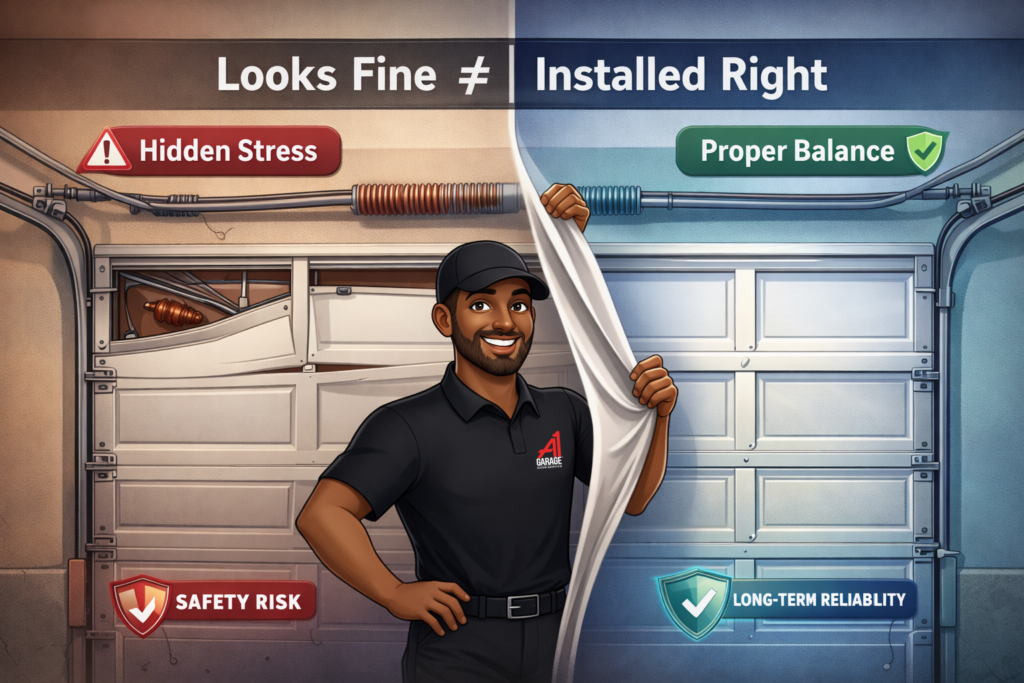
Your garage door looks great. But was it installed correctly, and do you know what happens if it wasn’t?
Many homeowners assume that if a garage door opens and closes, the job was done properly. The truth is, installation quality determines whether a garage door is safe, reliable, and built to last, or whether it quietly develops problems that lead to breakdowns, voided warranties, and costly repairs.
In this guide, we explain why professional garage door installation matters more than most people realize, what goes wrong when corners are cut, and how trained professionals install doors differently to protect your home, your family, and your investment for the long haul.
1) Why installation quality matters (more than most people think)
As we’ve discussed previously in these guides, your garage door is the largest moving object on your home. If it’s not installed correctly, it can become unsafe, even if it’s a premium door with premium hardware.
At A1 Garage Door Service, we like to keep things simple. Garage door hardware quality varies. For example, there are lighter-quality “cookie-cutter” parts and there are higher-end heavier-duty parts.
What’s key to understand is that the quality of the door’s installation can make those differences irrelevant, especially if the installed system is binding or misaligned.
 A1 Pro Insight:
Even a quality garage door part can fail early if it’s under constant stress due to a poor installation.
2) What goes wrong with poor installs (the domino effect)
A bad install usually starts with alignment problems that create pinch points and binding. From there, failures stack up:
Common install mistakes, the problems they lead to, and the results they produce:
- Panels not level/plumb leads to binding in the curved track and produces premature wear.
- Track pitched incorrectly leads door binding near the floor and results in opener reverses or strains.
- Trim installed too tight leads to the door scraping the trim and results in panel damage and cracking.
- Extra stress on hinges leads to hinges snapping (even heavy-duty hinges) and results in expensive repairs.
The list of possible issues is long because every part of the system is connected. If one part of the door stresses from a poor install, problems can cascade through the system and eventually lead to an expensive repair.
3) What pros do differently (and why it matters)
When it comes to assessing a customer’s garage door, professional installers don’t simply “eyeball it” and get to work. At A1, our top priority is to execute a thorough, assessment of a customer’s garage door to completely understand what the problem is.
Two critical safety measures that go into every A1 assessment include:
- A)Weighingthe door
Door weight determines spring sizing. If a garage door system’s springs are wrong, the whole system is wrong. - B)Performinga three-point balance test
Homeowners must understand that there is a DIY version of the door balance test, and there is a pro-version.
The DIY Door Balance Test
The DIY test answers one basic question: “Is my door obviously out of balance?” We’ve discussed this test in previous guides about DIY maintenance. It’s perfectly safe for homeowners to perform.
How It’s Done
- Close the garage door.
- Pull the emergency release.
- Lift the door by hand.
What You’re Looking For
- The door should feel relatively light.
- It should stay in place when lifted halfway.
- It should not slam down or shoot up.
A1 Pro Tip:
The DIY test tells you if there’s a problem, not how bad it is or what caused it. A door can pass a DIY test and still be overworking the opener, wearing springs prematurely, and one season away from failure
The Pro Door Balance Test
The professional test answers a deeper question: “Is this door balanced correctly across its entire travel, under real operating conditions?” This test can only be performed by trained professionals.
How It’s Done
To test a garage door’s balance, a pro will:
- Disconnect the opener
- Move the door slowly through every stage of travel
- Test balance at multiple heights, not just halfway
- Measure spring tension and cycle wear
- Check side-to-side balance
- Watch how the door behaves in the track radius
- Assess opener force settings and compensation
What the Pro Test Catches
- Early spring fatigue
- Imbalanced spring pairs
- Doors that “float” incorrectly
- Binding that only shows under slow movement
- Hidden safety risks
A1 Pro Insight:
The DIY balance test catches obvious danger. The pro balance tests prevent future failure.
4) The warranty problem most homeowners don’t see coming
Many garage door opener manuals state that warranty coverage depends on the door being properly balanced.
Homeowners often install a new motor assuming the door is fine because “it goes up and down.” But if the door isn’t balanced, the opener can fail early, and then the warranty claim gets complicated.
At A1, we educate homeowners on why DIY installs may be cheaper today, but often more expensive later. Pro-installed systems often include built-in service: a certified service company comes out and handles any problems the system may have. This is very often NOT the case with DIY-installed systems.
A1 Pro Promise:
When A1 Garage Door Service installs your opener, you can be assured that if anything goes wrong with it, we’ll be there to fix it. Guaranteed.
5) How to vet an installer (simple checklist)
Before they can work on a homeowner’s garage door, all A1 technicians attend our internal process training academy with pass/fail standards and certification. The training is thorough and rigorous. Even experienced techs might not pass at first. At A1, we stand on the belief that standards protect homeowners.
Here’s an A1-approved checklist for how you can vet any company:
- Are they licensed/insured/bonded?
- Do they have formal training or certifications?
- Do they weigh the door and balance test it? (Ask directly.)
- What does their warranty include—parts only, or parts + labor?
- Will they service what they install?
6) Two real “horror stories” (and what they teach)
When it comes to garage door problems and fiascos, A1 technicians have seen it all. Here are two DIY mishaps we can share, so you don’t suffer the same fate.
One of our A1 techs arrived at a customer’s home to find a 250-plus-pound garage door lying on the garage floor! He looked at the ceiling and saw it was torn to shreds. The door and floor were caked in drywall dust.
He knew what had happened. The door had been installed with the supports anchored into the ceiling’s drywall instead of wooden joists. It was an obvious DIY effort that thankfully did not result in anyone getting hurt.
A1 Pro Tip:
It’s human not to know what you don’t know. But if you don’t know that heavy fixtures can’t be anchored in drywall, you should call a professional for all things garage door-related.
Another, less horrific story proves why small shortcuts can lead to big problems. Unfortunately, we see this story all the time. A door that’s experienced several DIY fixes over time ends up with mismatched components, including different drums.
When techs see this, they often must take action and replace the mismatched parts with matching components to ensure the garage door is safe and functional and doesn’t fail to the point of requiring a full replacement.
In One Minute: Key Takeaways
- A garage door is the largest moving object in your home, often weighing 150–300 pounds, so installation quality directly affects safety.
- Even the best garage door can fail if it’s installed incorrectly. Poor installs create binding, stress, and early part failure.
- Common problems from bad installation include pinch points, misaligned tracks, cracked panels, broken hinges, and opener strain.
- Professional installers weigh the door, size the springs correctly, and perform balance tests—steps most DIY installs skip.
- An unbalanced door can damage the opener and may lead to voided manufacturer warranties.
- Box-store warranties often require homeowners to remove and ship parts, while professional installs frequently include built-in service support.
- Proper installation improves safety, performance, lifespan, and long-term cost savings.
Bottom line: Installation isn’t just a step; It’s the foundation of your garage door’s performance, safety, and reliability.
If you want your garage door installed safely, correctly, and backed by real warranties, trust the professionals at A-1 Garage Door Service.
Our certified technicians are trained to do it right, from proper door weighing and balance testing to precision installation that protects your home, your family, and your investment.
Don’t risk shortcuts with the largest moving part of your home.
Schedule a professional installation or inspection with A-1 today and get the peace of mind that comes from expert work done right the first time.
Frequently Asked Questions: Why Professional Garage Door Installation Matters
Does professional garage door installation really matter?
Yes. Professional garage door installation directly impacts safety, performance, and longevity. Most garage doors weigh between 150 and 300 pounds, and even small installation errors can lead to binding, premature wear, and unsafe operation.
Is it safe to install a garage door yourself?
DIY garage door installation can be risky. Garage doors involve heavy panels and high-tension springs. Improper installation can cause the door to bind, fall, or place excessive strain on the opener, creating serious safety hazards and costly repairs.
What problems are caused by a poor garage door installation?
Poor installation can lead to pinch points, track binding, misaligned panels, cracked door sections, broken hinges, scraping against trim, and opener issues such as reversing, stalling, or early failure.
How can you tell if a garage door is installed incorrectly?
Common warning signs include a door that jerks or binds, feels heavy when lifted by hand, rubs against trim, makes loud popping or grinding noises, reverses before closing fully, or closes unevenly.
Why is garage door balance so important?
Proper balance ensures the door moves smoothly without putting excessive strain on the opener or hardware. When a door is out of balance, the opener becomes the “muscle,” which accelerates wear and increases the risk of breakdowns.
What is a three-point garage door balance test?
A three-point balance test checks whether the door can hold its position at multiple points of travel. With the opener disconnected, the door should remain steady near closed, mid-travel through the curved track, and near open without drifting or slamming.
Do professional installers weigh the garage door?
Yes. Professional installers typically weigh the door to size the springs properly. Correct spring sizing is critical for safe operation, smooth movement, and long-term performance.
Can poor installation damage a garage door opener?
Yes. If the door binds or is not balanced, the opener has to work harder than designed. This can cause premature motor wear, limit-setting problems, and early opener failure.
Can DIY installation void a garage door or opener warranty?
It can. Many manufacturers require proper installation and door balance for warranty coverage. If the door is out of balance or installed incorrectly, warranty claims may be denied.
What’s the difference between a box-store opener warranty and a professional warranty?
Box-store warranties often require homeowners to remove and ship parts back to the manufacturer. Professional installations typically include service support, where the company returns to diagnose and handle covered parts and labor, depending on the warranty plan.
Why do garage door parts fail earlier after a bad install?
Misalignment creates constant stress throughout the system. That stress leads to faster wear on hinges, rollers, tracks, and panels—even when high-quality parts are used.
What questions should homeowners ask before hiring a garage door installer?
Ask whether the company is licensed and insured, if they weigh the door and balance it properly, whether they perform a balance test, what the warranty covers, and if they service what they install.
How do professional garage door companies vet or train installers?
Many professional companies use formal training programs with certification and performance standards. Installers must meet specific requirements before working independently to ensure consistent quality and safety.
Is builder-grade garage door installation the same as professional installation?
Not always. Builder installs can vary widely depending on subcontractors. A door may look fine while being improperly anchored or left out of balance, which can cause failures months later.
What is the long-term return on investment of professional installation?
Professional installation reduces breakdowns, protects warranties, improves safety, and extends the life of the door and opener—often saving homeowners money over time compared to repeated repairs from poor installation.