



Blog | GARAGE DOORS
Garage Lighting Design for Work, Fitness & Entertaining: The Upgrade That Changes Everything…Without Tearing Down Walls
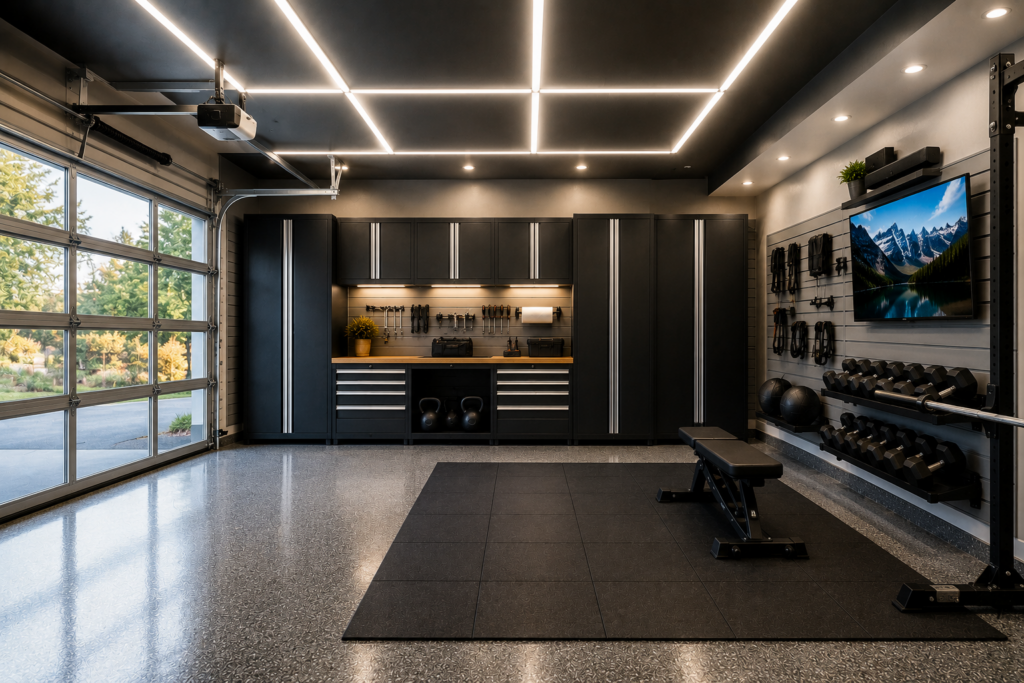
When homeowners convert a garage into a gym, office, workshop, or entertainment space, they often focus on insulation, flooring, and climate control first.
Lighting usually comes later.
But here’s the reality:
Lighting is one of the least expensive upgrades you can make, and one of the most transformative for your upgraded space.
It changes:
- How large the space feels
- How productive you are
- How energized a workout feels
- How inviting the room becomes at night
In many garage conversions, lighting is the difference between a space that feels improvised and one that feels intentional.
Below is a practical guide to garage lighting design—covering brightness levels, fixture types, color temperature, cost ranges, energy use, common mistakes, and how garage doors influence natural light performance.
Why Lighting Is Strategic
Unlike insulation or HVAC, lighting:
- Doesn’t require structural modification
- Can be installed in a single day
- Offers immediate visual impact
- Improves mood and usability instantly
Typical Upgrade Cost: $500–$2,500
For many homeowners, that’s a modest investment compared to flooring, insulation, or HVAC systems—yet the experiential return is dramatic.
Step One: How Bright Should a Garage Be?
Brightness is measured in lumens, not watts.
Recommended Lumens Per Square Foot
| Use Case | Lumens Per Sq. Ft. |
| Storage / Parking Only | 50–75 |
| Workshop | 75–100 |
| Home Gym | 75–125 |
| Office / Studio | 100+ |
| Entertaining Space | Layered lighting (75 ambient + accent) |
Example:
A 400 sq. ft. garage gym aiming for 100 lumens per sq. ft. requires approximately 40,000 lumens total output.
 A1 Pro Insight: More Light Is Not Always Better
Over-lighting without diffusion creates glare and fatigue. Proper distribution matters more than raw output. Balanced spacing and layering outperform a single ultra-bright fixture.
Fixture Types: What Works Best
-
LED Panel Lights
These are flat, rectangular fixtures that distribute light evenly.
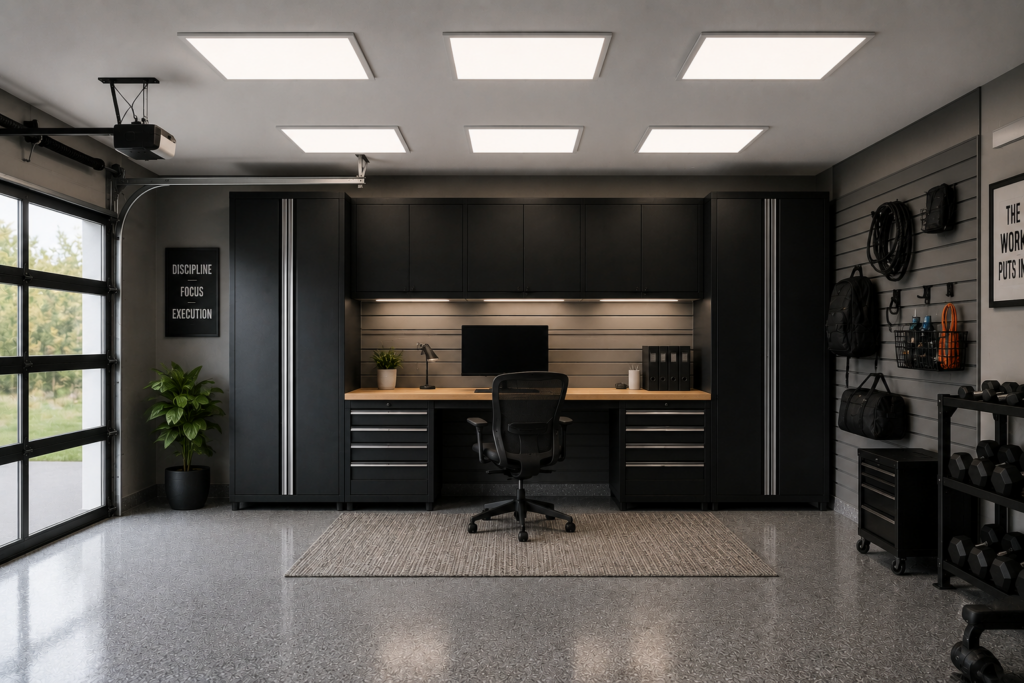
Best For:
- Offices
- Clean, modern conversions
- Even overhead lighting
Pros
- Soft, wide coverage
- Minimal glare
- Professional aesthetic
Cons
- Require ceiling mounting
- May look commercial if not spaced thoughtfully
-
LED Strip / Linear Fixtures
Long, narrow fixtures ideal for grid layouts.
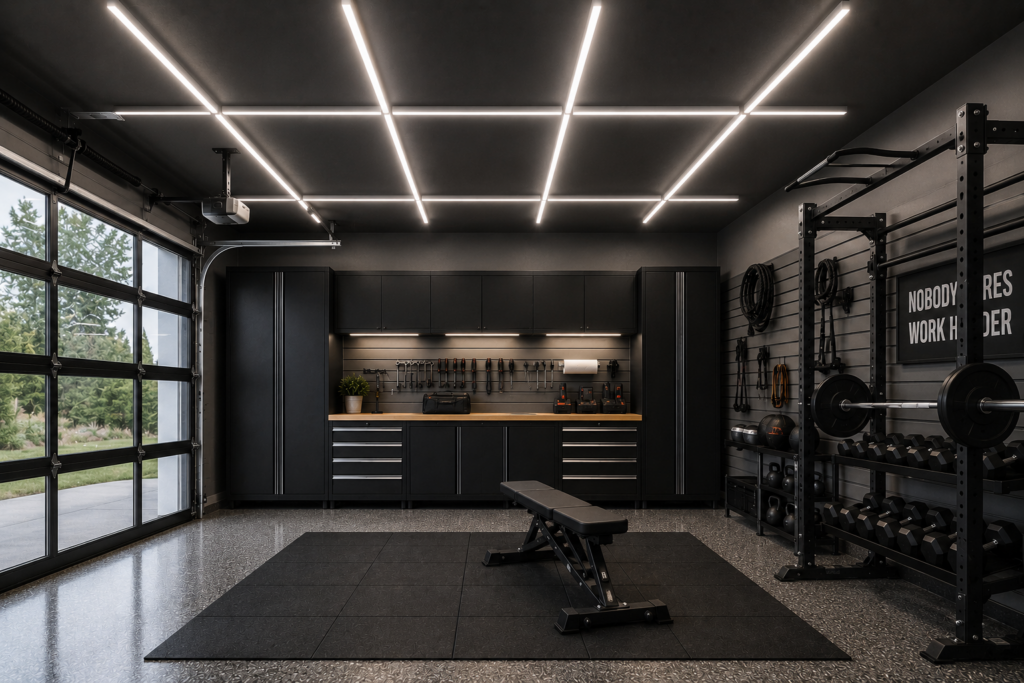
Best For:
- Garages with exposed ceilings
- Gyms
- Workshop layouts
Pros
- Customizable patterns
- Strong output
- Modern appearance
Cons
- Can create harsh shadows if poorly spaced
-
High-Bay LED Lights
Powerful fixtures designed for high ceilings.
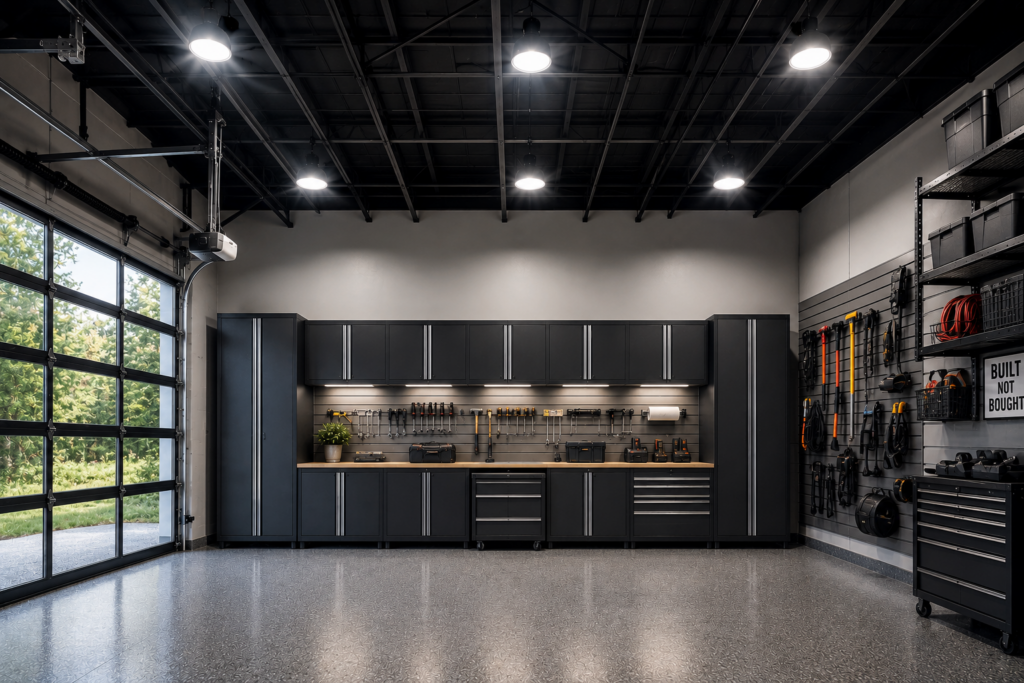
Best For:
- Garages with 10+ ft ceilings
- Industrial-style spaces
Pros
- Extremely bright
- Wide coverage
Cons
- Can cause glare
- Overkill for standard 8-ft ceilings
A1 Pro Insight: Ceiling Height Determines Fixture Type
In standard 8–9 ft ceilings, high-bay fixtures often create unnecessary glare. Linear or panel systems typically provide better light distribution.
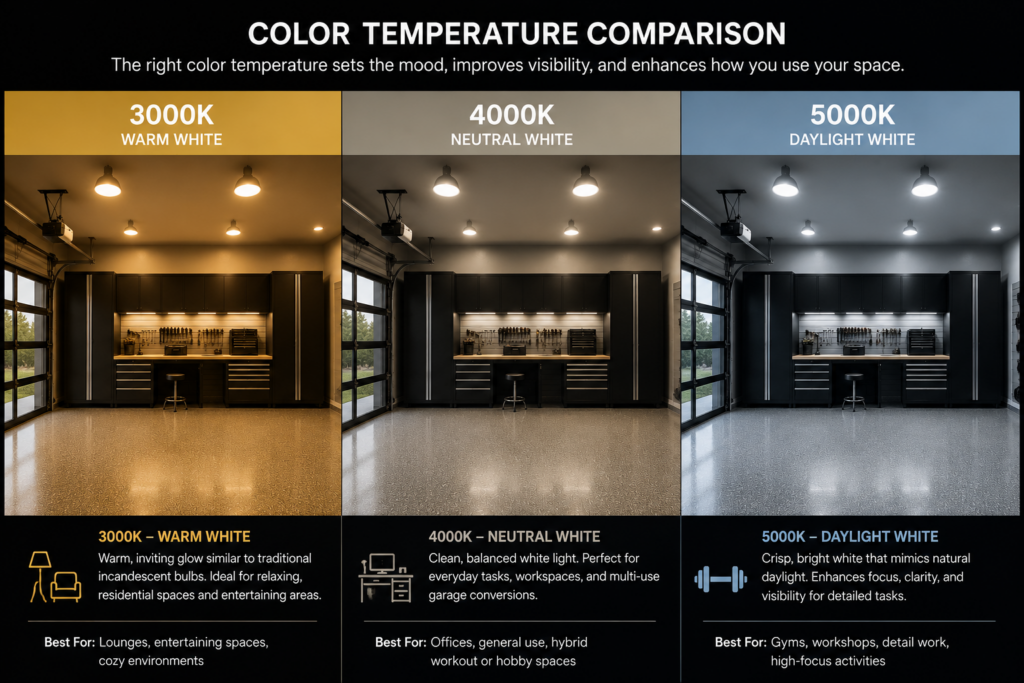
Color Temperature: 4000K vs 5000K
Color temperature dramatically affects mood.
- 3000K → Warm, yellow (cozy, residential)
- 4000K → Neutral white (balanced, modern)
- 5000K → Daylight white (bright, energizing)
Best Uses
4000K
- Hybrid spaces
- Offices
- Entertaining areas
- Balanced environments
5000K
- Garages focused on detailing
- Workshops
- Fitness spaces
- High-focus tasks
A1 Pro Insight: 5000K Isn’t Always Better
While 5000K feels bright and energizing, it can feel sterile or harsh in social spaces. Many homeowners prefer 4000K for mixed-use garage conversions.
Energy Consumption Comparisons
Modern LED systems are extremely efficient.
Example:
- 40,000 lumens of LED lighting
- Typically consumes 300–500 watts total
- Monthly cost: approximately $5–$20 depending on usage
Compare that to older fluorescent systems:
- Higher wattage
- Flickering over time
- Shorter lifespan
LED lighting:
- Lasts 30,000–50,000 hours
- Generates minimal heat
- Reduces maintenance
Installation Complexity
Lighting upgrades range from simple to moderate complexity.
DIY-Friendly:
- Plug-in LED strip kits
- Surface-mounted fixtures
Requires an Electrician:
- Hardwired panel systems
- New circuit installation
- Switch relocation
- Smart dimmer integration
Professional installation cost: $300–$1,000, depending on complexity.
A1 Pro Insight: Plan Lighting Before Ceiling Storage
If installing overhead racks or a side-mounted opener, lighting layout should be coordinated in advance. Fixtures blocked by storage defeat the purpose of upgrading.
Common Garage Lighting Mistakes
-
Center-Only Lighting
One central fixture creates:
- Dark corners
- Uneven brightness
- Shadow-heavy workspace
Distributed lighting is essential.
-
Ignoring Vertical Surfaces
Lighting that only shines downward neglects walls.
Well-lit vertical surfaces:
- Make the garage feel larger
- Improve overall brightness perception
-
Overexposed Glare on Glossy Floors
Highly reflective epoxy or polyaspartic flooring can amplify glare if the lighting is poorly angled.
A1 Pro Insight: Matte Finishes Reduce Glare
If installing high-gloss flooring, lighting selection and angle should be planned accordingly. Matte or satin finishes reduce reflection fatigue.
Layered Lighting for Entertaining
Converted garages used for entertaining benefit from multiple layers:
- Overhead ambient lighting
- Wall-mounted sconces
- Under-cabinet task lighting
- Dimmable circuits
Dimmers transform a gym-like brightness into evening lounge ambiance instantly.
Natural Light: The Role of the Garage Door
Artificial lighting is only part of the equation.
Glass-panel garage doors and insulated window inserts:
- Increase natural daylight
- Reduce daytime electricity usage
- Visually expand the space
A1 Pro Insight: Light Without Insulation Is a Tradeoff
Non-insulated glass doors increase daylight but can reduce thermal performance. Modern insulated glass-panel doors balance both—providing light without sacrificing temperature stability.
Cost Overview
Typical garage lighting upgrades:
| Upgrade Type | Typical Cost |
| Basic LED swap | $200–$500 |
| Full grid linear LED layout | $800–$2,000 |
| Panel lighting system | $1,000–$2,500 |
| Smart/dimmable integration | +$300–$800 |
Most lifestyle garage lighting projects fall between $500 and $2,500 total.
Compared to flooring or HVAC, this is one of the most cost-effective upgrades in the entire conversion.
Best-For Recommendations
Workshop-Focused Garage
- 5000K linear LED grid
- High lumen density
- Wall wash lighting
Home Gym
- 4000K–5000K
- Even distribution
- Dimmable option
Office or Studio
- 4000K panels
- Balanced wall illumination
- Reduced glare
Entertaining Space
- Layered lighting
- Dimmable circuits
- Accent wall fixtures
The Bigger Picture: Light Shapes Behavior
Bright spaces get used more. Dim, shadowed garages feel temporary—even if fully insulated.
Lighting influences:
- Energy levels
- Focus
- Comfort
- Aesthetic pride
And when paired with an insulated, glass-panel garage door that invites natural light during the day, the transformation feels complete. The garage door may be the portal.
But lighting determines what that portal reveals. In many garage conversions, it’s the simplest upgrade—and the one homeowners notice immediately.