



Blog | GARAGE DOORS
Garage Door Symptoms and Diagnosis Guide
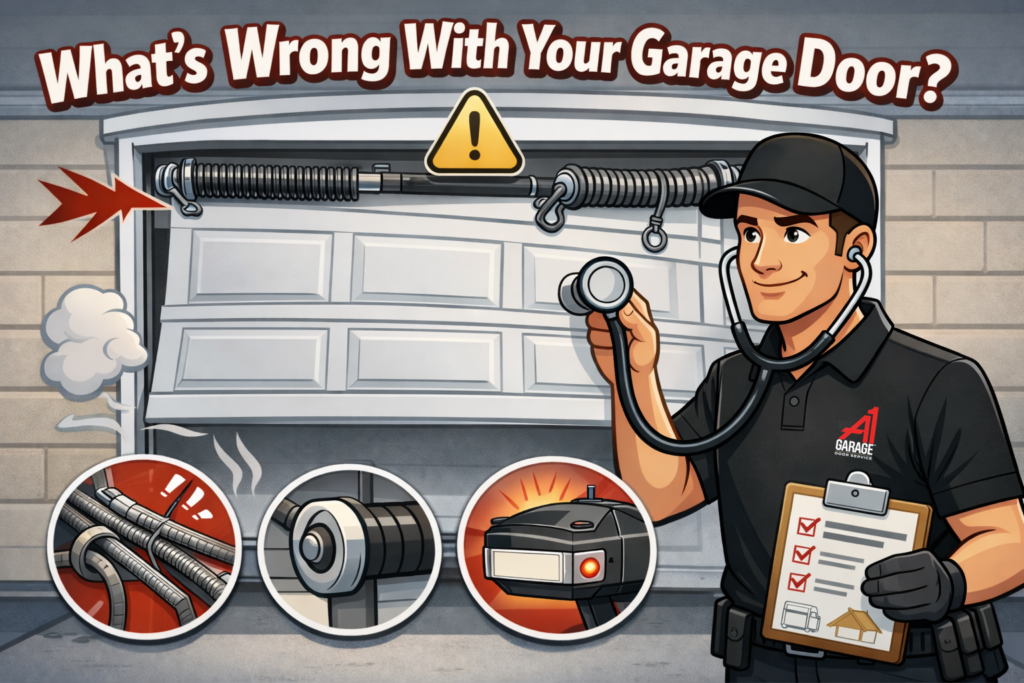
Is Your Garage Door Acting Strange? Here’s What the Symptoms Really Mean
Quick Answers to Common Garage Door Problems
In a hurry and don’t have time to read the full guide? No problem, here are the direct answers:
- Garage door won’t open? Check power, breaker, and remote batteries first. If you hear the motor but the door does not move, you may have a broken spring.
- Garage door won’t close? Check safety sensors. Clean them and make sure they are aligned.
- Door moves a few inches and stops? Likely a force, travel, or internal motor issue. Call a professional.
- Grinding or squealing noise? Usually rollers, hinges, bearings, or lack of lubrication.
- Door feels heavy? Springs may be worn or broken.
- Remote works sometimes but not every time? Start with batteries. Then check for LED light or smart device interference.
- Never touch: Broken springs, frayed cables, off-track doors, damaged spring pad.
- Safe DIY: Lubrication, visual checks, safety tests.
- Best advice: Annual tune-ups prevent emergencies.
Now let’s break it all down.
Why This Matters
Is your garage door suddenly refusing to open or close? Or maybe it still moves, but is it loud, shaky, or feels heavier than it used to?
At A1, customers often ask us, “My garage door just seems like it’s not the same. What’s wrong?” Trust us. We get this all the time.
In this guide, we’ll walk through the most common garage door symptoms and what they usually mean, based on A1’s extensive technician training and real-world service calls.
By the end, you’ll know what you can safely check yourself, what you should never touch, and when it’s time to call a professional.
Why Won’t My Garage Door Open?
This six-word question is the most searched garage door-related query online. The real answer depends on what the door is doing.
If we think as a doctor, the question becomes, “What symptoms are my garage door presenting?”
Step 1: Check the Basics
Before assuming the worst about your garage door, look for the simplest explanation:
- Check your breaker.
- Make sure the opener has power.
- Replace remote batteries.
- Try the wall button.
Sometimes the problem has an answer that really is that simple. But not always.
If You Hear the Motor but the Door Does Not Move
Your garage door may have:
- A broken spring
- A worn spring
- A stripped operator
- A disconnected trolley
If you look up and see a spring separated into two pieces, stop immediately. Do not touch it. Broken springs carry extreme tension and are very dangerous, even for trained professionals.
 A1 Pro Safety Tip:
Regular readers of A1 expert guides know that we strongly advise calling a certified professional for any assessment or work that involves garage door springs. It’s not worth risking serious injury. Call a pro.
Why Won’t My Garage Door Close?
This answer is usually different from “why won’t my door open?”
Check Your Safety Sensors First
Look at the small sensors near the bottom of the track.
- One should be green.
- One should be amber.
- If they are (or one is) blinking or flickering, clean them.
- Make sure nothing is blocking them.
Common causes for sensor misalignment:
- Trash cans bumping sensors
- Tools leaning against them
- Dust buildup
- Sun glare
A1 Pro Tip:
Adjusting safety sensors is one of the easiest garage door fixes for homeowners.
If the Door Moves a Few Inches and Stops
This symptom often points to:
- Force settings
- Travel limits
- Internal motor modules
If the door moves three inches at a time, stops, and repeats, call a professional.
That is not a DIY fix that untrained homeowners should attempt.
A1 Pro Safety Tip:
That symptom usually points to an internal motor, force, or RPM sensor issue. Those components involve electrical systems and calibrated safety settings, which require professional tools and training to diagnose safely and correctly.
Why Is My Garage Door Making Noise?
Noise is one of the top problems homeowners ask us about at A1. When it comes to garage doors, different sounds mean different issues.
Grinding Noise
Grinding almost always is the result of metal rubbing against metal.
Likely causes include:
- Worn rollers
- Dry bearings
- Track friction
High-Pitched Squealing
This sound can usually be quieted with proper lubrication. Rollers and hinges need garage-specific lubricant.
Regular readers of A1 guides have heard this warning many times: Do not use WD-40 to lubricate your garage door parts. It is a solvent, not a lubricant. Using WD-40 will only attract dust and make things worse.
Popping Sounds
Popping sounds are often present due to the springs becoming dry. Sometimes, however, panel flexing is the root problem. At the same time, popping noises could also signal structural issues.
A1 Pro Tip:
If proper lubrication does not quiet your door’s popping sounds, call a professional. Panel and structural work should NOT be handled by untrained homeowners.
Why Does My Garage Door Feel Heavy?
A properly balanced door should lift easily with one hand.
If your door feels heavy:
- A spring may be broken.
- A spring may be worn.
- A wood door may have absorbed moisture.
Springs are the door’s counterbalance system and its muscle fibers. If springs are weak, your opener struggles. That invariably leads to bigger repairs.
Remote and Keypad Problems
We at A1 see this becoming an increasingly popular problem as homeowners adopt more technology int their garage door systems. If your remote works some of the time but not all of the time, try these steps:
Step 1: Replace Batteries
Even if they “sort of” work. Intermittent function often means low battery.
Step 2: Check for Interference
Common things that can interfere with a remote’s signal include:
- LED light bulbs
- Baby monitors
- Alarm systems
- Irrigation systems
- Smart home devices
LED bulbs that are not designed for garage openers can interfere with a remote system’s radio frequency. Switching to manufacturer-approved bulbs usually solves this problem.
What Homeowners Should Never Touch
This is critical for your safety. Call a professional immediately if you see:
- Broken springs
- Frayed cables
- Cable off drum
- Door off track
- Cracked spring pad
- Bottom bracket damage
These components hold extreme tension. DIY attempts can turn a repair into a door replacement.
What Homeowners CAN Safely Do
Here is your A1-approved, DIY-safe checklist.
1. Lubrication
Always use garage-door-specific lubricant, NOT WD-40!
Apply the proper lubricant to:
- Rollers
- Hinges
- Bearings
- Springs (light coat)
2. Three-Point Balance Test
- Disconnect opener.
- Lift door manually.
- Let go mid-travel.
The door should stay in place. If it shoots up or falls down, call a pro.
3. Force Test
Place a 2×6 board on ground under the center of door. Close the door. It should reverse quickly when it touches board. If it does not, schedule a service call with a reputable garage door company.
Cost of Ignoring Symptoms
Small issues have a way of becoming big, expensive problems fast if not addressed when symptoms first present.
For example, loose spring tension leads to opener strain which leads to gear damage and ends up with motor failure.
The takeaway? If not handled in a timely manner, a spring replacement can turn into a full door replacement at the homeowner’s expense and chagrin.
A1 Pro Insight:
Preventive maintenance costs far less than emergency repairs.
The Real Solution: Annual Tune-Ups
Just like your car, your garage door needs regular maintenance to continue to operate effectively and efficiently.
Annual service to address includes:
- Adjusts spring tension
- Lubricate moving parts
- Checks safety systems
- Inspects structural integrity
Be proactive, not reactive.
In One Minute
- Check power and batteries first.
- Clean and align safety sensors.
- Never touch springs or cables.
- Lubricate properly.
- Test balance yearly.
- Address noise early.
- Schedule annual tune-ups.
Ready for a professional diagnosis of your garage door? Schedule your garage door inspection with A1 today.
Frequently Asked Questions about Common Garage Door Symptoms
Why won’t my garage door open?
The most common reasons are power issues, dead remote batteries, or a tripped breaker. If you hear the motor running but the door does not move, you may have a broken or worn spring and should call a professional.
Why won’t my garage door close?
In most cases, misaligned or blocked safety sensors prevent the door from closing. Clean the sensors, check for obstructions, and make sure the indicator lights are solid before assuming a larger issue.
Why is my garage door making grinding or squealing noises?
Grinding usually means metal-on-metal contact from worn rollers or bearings. Squealing often indicates a lack of proper lubrication on moving parts like rollers, hinges, or springs.
Why does my garage door feel heavy when lifting it manually?
A garage door that feels heavy typically has a worn or broken spring. Springs counterbalance the door’s weight. When they fail, the full weight of the door must be lifted manually.
What garage door problems should I never try to fix myself?
Homeowners should never attempt to repair broken springs, frayed cables, off-track doors, or damaged bottom brackets. These components are under high tension and can cause serious injury if handled improperly.
How often should I service my garage door?
Garage doors should be professionally inspected and tuned up at least once a year. Regular maintenance helps prevent unexpected breakdowns, extends the life of the system, and ensures safety features are working properly.