



Blog | GARAGE DOORS
Can Your Garage Accommodate a Side-Mounted Garage Door Opener?
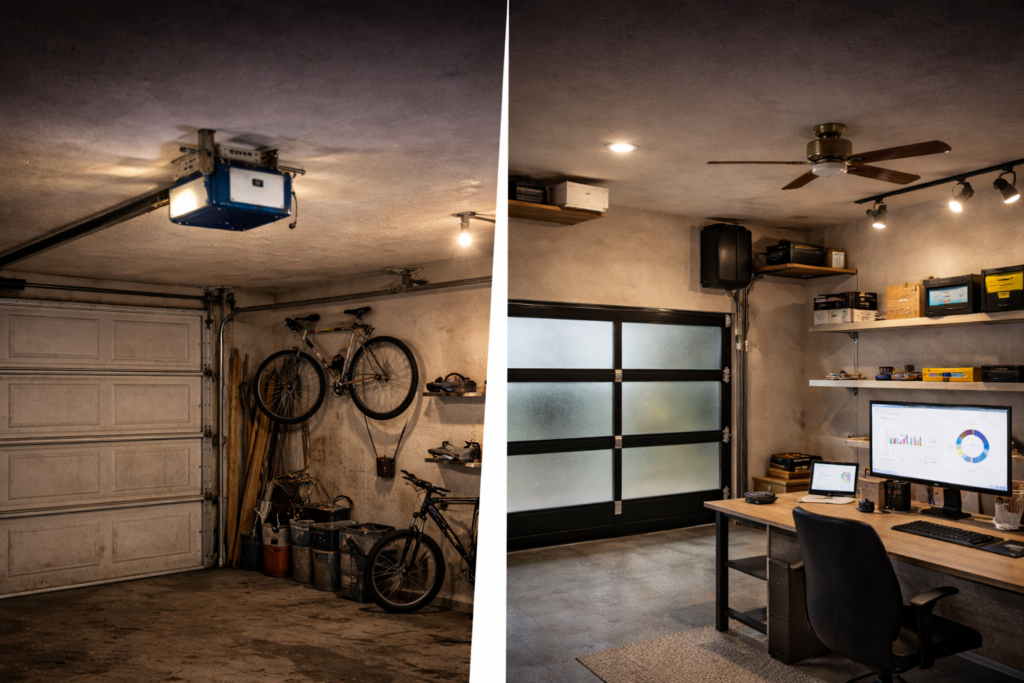
What to Know Before You Clear the Ceiling
When homeowners convert a garage into a gym, workshop, or hybrid living space, the ceiling suddenly matters.
That bulky, center-mounted garage door opener—with its long rail running overhead—can feel intrusive in a space designed for lighting, storage racks, or even overhead fans. That’s when side-mounted garage door openers enter the conversation.
Also known as jackshaft openers, wall-mounted systems free up ceiling space and create a cleaner architectural look. They are not, however, universal upgrades. Not every garage can accommodate one without specific conditions first being met.
In this exclusive guide, we’ll walk through the pros, the drawbacks, what to measure, and the brands worth considering—using the same transparent framework we apply across this series.
What Is a Side-Mounted (Jackshaft) Garage Door Opener?
Unlike traditional openers that pull the door up via a trolley rail mounted to the ceiling, a side-mounted opener installs on the wall beside the garage door and turns the torsion bar directly.
Instead of pulling the door, it rotates the shaft that lifts it.
The result:
- No center rail
- No hanging motor
- A cleaner ceiling
- More flexibility overhead
For converted garages, this can be transformative. But before you can install a jackshaft opener, you must confirm your door system is compatible.
What Your Garage Must Have
A side-mounted opener is not plug-and-play in every home.
Here’s what must be present:
- A Torsion Spring System
Side-mounted openers require a torsion spring system mounted above the door. If your garage uses extension springs (the long springs that stretch alongside horizontal tracks), conversion will be necessary.
 A1 Pro Insight: Spring System Conversion Cost
If your garage has extension springs, converting to torsion typically costs $300–$800, depending on door size and hardware. This is often required before installing a jackshaft opener.
- Adequate Side Clearance
You’ll need:
- 8–12 inches of space beside the garage door opening
- Clear wall surface near the torsion bar
- An outlet within reach (or wiring installed)
Some larger commercial-grade openers may require even more space.
- Proper Door Balance
Side-mounted openers rely heavily on a properly balanced door. If the door is heavy, warped, or poorly insulated, performance may suffer.
A1 Pro Insight: Door Weight Matters
Heavier wood doors or older uninsulated steel doors may strain smaller jackshaft motors. If you are upgrading to a side-mounted opener, it’s worth evaluating the door’s insulation rating and structural integrity at the same time.
The Pros of a Side-Mounted Opener
- Ceiling Clearance
This is the headline benefit.
Removing the center rail:
- Allows overhead storage systems
- Supports cleaner lighting layouts
- Makes room for ceiling fans or fitness rigs
- Enhances visual design
For lifestyle garages, this changes the feel dramatically.
- Quieter Operation
Because the motor mounts directly to the torsion bar and doesn’t rely on long chain or belt drives, vibration is reduced.
Many homeowners report:
- Less rattling
- Smoother motion
- Quieter overall performance
This matters if your garage doubles as:
- A home gym
- A workspace
- An entertainment area
- Built-In Smart Features
Most modern jackshaft openers include:
- Wi-Fi connectivity
- Smartphone control
- Automatic door lock integration
- Battery backup
These are often premium-tier features.
A1 Pro Insight: Battery Backup Is Increasingly Required
In some states (like California), battery backup systems are required by law. Many side-mounted units include this standard, making them future-ready even if not legally required in your region.
The Cons (And When They Matter)
No system is perfect.
- Higher Cost
Side-mounted openers cost more than traditional models.
Cost Breakdown
- Standard ceiling-mounted opener installed: $300–$600
- Side-mounted opener installed: $800–$1,500
Price depends on:
- Electrical work required
- Spring conversion
- Structural modifications
- Door compatibility
A1 Pro Insight: Why the Price Gap Exists
Jackshaft openers include more integrated technology, automatic locking systems, and heavier-duty components. The motor directly drives the torsion shaft—requiring greater torque precision.
- Not Ideal for Low Headroom Systems
If your garage door uses:
- Low-headroom track configurations
- Non-standard torsion assemblies
- Specialty custom doors
Installation may require additional parts or may not be feasible.
- Dependence on Proper Installation
Because the opener directly manipulates the torsion shaft, improper installation can lead to:
- Shaft misalignment
- Cable tension issues
- Premature wear
This is not a recommended DIY project.
What to Measure Before You Decide
Here’s a quick homeowner checklist:
Measure Side Clearance
Minimum 8 inches from the edge of the door to the side wall obstruction.
Confirm Torsion Bar Length
Ensure sufficient exposed torsion bar for motor coupling.
Check Outlet Placement
Is there a nearby outlet? If not, factor in electrical installation.
Evaluate Door Condition
Is it insulated? Is it balanced? Is it structurally sound?
A1 Pro Insight: Insulated Doors Pair Better
Side-mounted openers shine in climate-controlled garages. If you are investing in a premium opener but keeping a thin, non-insulated door, you are missing performance potential. Insulated doors stabilize operation and reduce stress on the motor.
Brands Worth Considering
When it comes to jackshaft openers, a few brands dominate.
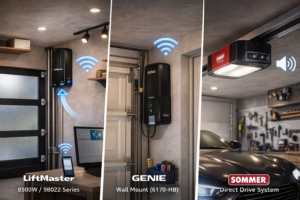
LiftMaster 8500W / 98022 Series
- Industry standard
- Built-in Wi-Fi
- Automatic deadbolt lock
- Battery backup
- myQ smart system integration
Price Installed: Typically $900–$1,400
Best for:
- Premium residential installations
- Smart-home integration
- Daily-use garages
Genie Wall Mount (6170H-B)
- Compact design
- Battery backup
- Lower price tier than LiftMaster
Installed Cost: $800–$1,100
Best for:
- Budget-conscious upgrades
- Standard-size doors
Sommer Direct Drive Systems
Though not side-mounted in the traditional sense, Sommer’s ceiling-mounted direct drive system offers similar quiet performance.
Best for:
- Ultra-quiet environments
- Alternative to jackshaft systems when side clearance is limited
A1 Pro Insight: Brand Isn’t Everything
Proper sizing and professional installation matter more than brand name alone. A misaligned premium opener will underperform compared to a properly installed mid-tier unit.
Real-World Outcomes
Homeowners who upgrade to side-mounted openers often report:
- Cleaner ceiling aesthetic
- Better lighting flexibility
- Improved overhead storage capability
- Reduced operational noise
- Smoother daily function
However, the upgrade rarely makes sense in garages that remain purely vehicle storage areas without lifestyle conversion goals.
Are Side Openers Worth the Investment?
Here’s the honest answer.
If your garage is:
- Becoming a gym
- Functioning as a workspace
- Designed as an entertainment extension
- Being fully insulated and upgraded
Then yes, a side-mounted opener supports that transformation.
If your garage is:
- Strictly vehicle storage
- Not climate-controlled
- Not design-focused
A traditional belt-drive opener may be sufficient.
The Bigger Picture: It’s About Spatial Freedom
In a converted garage, every square foot matters—including overhead.
A side-mounted opener doesn’t just change mechanics. It changes how the ceiling functions:
- Storage racks move higher
- Lighting becomes cleaner
- Equipment fits better
- The space feels intentional
Just like flooring or insulation, the opener becomes part of the performance system.
And when the garage door is the portal to how you live, the machinery behind it should support—not limit—the space you’re building.