



Blog | GARAGE DOORS
Belt Drive vs. Chain Drive Garage Door Openers for Converted Garages
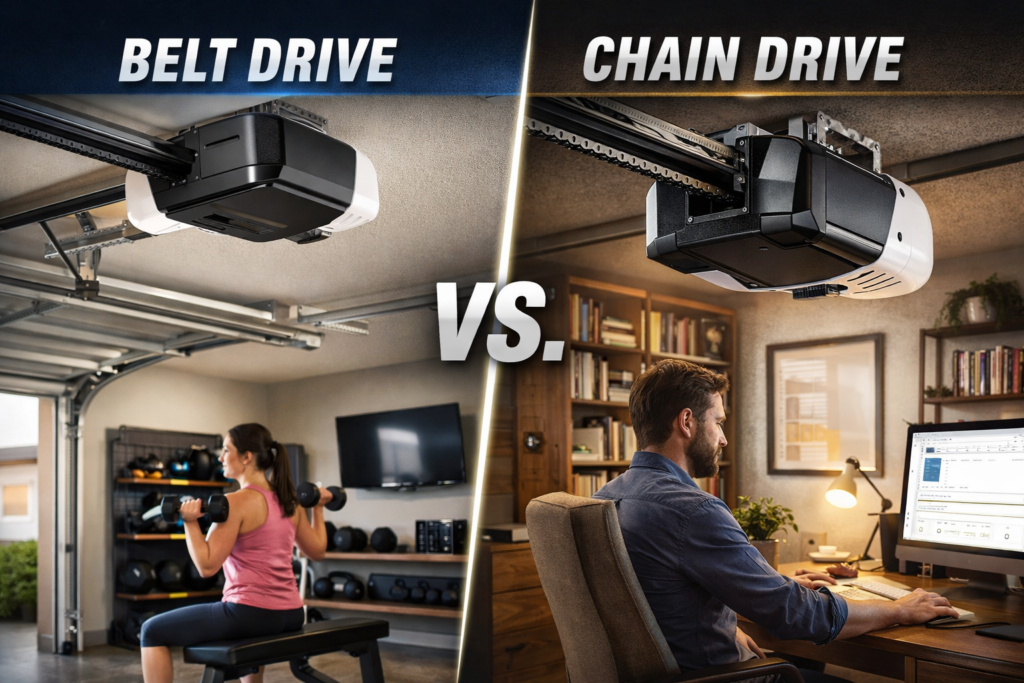
Which System Actually Fits the Way You Use Your Garage?
When homeowners upgrade their garage—whether for daily workouts, a home office, or simply quieter mornings—the garage door opener becomes more than a mechanical afterthought.
It becomes part of the experience.
And one of the most common questions we hear is:
Should I choose a belt-drive or a chain-drive opener?
Both systems lift your garage door reliably. But how they do it, and how that affects noise, durability, maintenance, and cost can significantly impact a garage that’s being used as more than a parking bay.
In this article, we break down the differences between belt and chain drive garage door openers using the same transparent framework we apply across this series. We’ll focus on cost, problems, comparisons, real-world performance, and best-use scenarios.
How They Work (The Simple Difference)
Both belt-drive and chain-drive systems use a trolley that moves along a rail to lift and lower the garage door.
The difference between the two systems is in what moves that trolley:
- Chain-drive openers use a metal chain (similar to a bicycle chain).
- Belt-drive openers use a reinforced rubber, polyurethane, or fiberglass belt.
Mechanically, they perform the same function. Experientially, they feel very different.
Chain-Drive Openers
The Traditional Workhorse
Chain-drive systems have been around for decades and remain common for one reason: they’re tough.
Cost (Price Transparency)
- Installed cost: $300–$600
- Premium chain-drive models: $500–$800
They are generally the most budget-friendly option.
Pros
- Durable and rugged
- Handles heavy doors well
- Lower upfront cost
- Proven long-term track record
Chain drives are often used in:
- Detached garages
- Rental properties
- Heavy wood door installations
The Drawbacks (Problems)
- Noticeably louder
- More vibration
- Requires periodic lubrication
- Can rattle over time

 A1 Pro Insight: Noise Is Structural, Not Just Annoying
In attached garages—especially those under bedrooms—chain vibration transfers into framing and drywall. What feels “a little loud” in the garage can feel much louder inside the home.
If your garage is becoming a gym or office, that vibration becomes more noticeable.
Real-World Performance (Outcomes)
Chain-drive openers are extremely reliable when properly maintained. Many last 10–15 years or more. However, noise tends to increase over time as components wear.
Best For
- Budget-conscious homeowners
- Detached garages
- Heavy, oversized doors
- Homes where noise isn’t a concern
Belt-Drive Openers
The Modern Standard for Quiet Performance
Belt-drive systems use reinforced belts instead of metal chains, dramatically reducing noise and vibration.
Cost (Big Five: Price Transparency)
- Installed cost: $400–$900
- Premium smart-enabled systems: $700–$1,200
On average, expect to pay $100–$300 more than a comparable chain-drive unit.
Pros
- Significantly quieter
- Minimal vibration
- Low maintenance
- Smoother operation
- Ideal for attached garages
For converted garages, belt-drive is often the preferred choice.
The Drawbacks (Problems)
- Slightly higher upfront cost
- Belt replacement may be needed over long timeframes (though uncommon)
- Lower-end models may struggle with extremely heavy wood doors

A1 Pro Insight: Most Modern Doors Don’t Need a Chain
Today’s insulated steel doors are lighter and better balanced than older solid wood models. In most residential scenarios, a properly sized belt-drive system provides more than enough lifting power.
Real-World Performance (Outcomes)
Homeowners who switch from chain to belt-drive frequently report:
- Dramatically reduced startup noise
- No rattling overhead
- Less structural vibration
- Smoother open/close cycle
In lifestyle garages—where you may be on a Zoom call, lifting weights, or hosting friends—this difference is noticeable.

Smart Features & Technology
Here’s where the gap narrows.
Most mid- to high-tier openers—both chain and belt—now include:
- Wi-Fi connectivity
- Smartphone app control
- LED lighting
- Battery backup
- Soft start/stop technology
Technology is no longer exclusive to belt-drive systems. The difference is primarily mechanical noise and vibration.
A1 Pro Insight: Smart Features Add Value Beyond Convenience
Integrated smart systems allow you to monitor door activity, receive open alerts, and manage access remotely. In converted garages—especially those storing equipment or used daily—this adds security and peace of mind.
What Impacts Longevity More Than Drive Type?
Here’s something many homeowners don’t hear:
The condition of your garage door itself impacts an opener’s lifespan more than chain vs. belt.
If your door:
- Is poorly balanced
- Has worn rollers
- Has damaged tracks
- Lacks proper insulation
The opener works harder—regardless of drive type.
A1 Pro Insight: Balance Test
Disconnect your opener and manually lift the door halfway. If it doesn’t stay in place, the door is unbalanced. Fixing this before installing a new opener can extend motor life dramatically.
Which Should You Choose?
Choose Chain Drive If:
- Your garage is detached
- Budget is your primary concern
- You have a heavy custom wood door
- Noise transfer isn’t a concern
Choose Belt Drive If:
- Your garage is attached to the home
- You’re converting the space to a gym, office, or lounge
- You want smoother daily operation
- You value quieter mornings and evenings
The Lifestyle Perspective
In a garage that remains strictly utilitarian, a chain-drive opener makes sense. It’s durable, affordable, and proven.
But in a garage that’s becoming part of how you live—train, work, gather, create—sound and vibration matter more.
A belt-drive system supports:
- Early workouts without waking the house
- Zoom calls without overhead rattling
- A cleaner, quieter opening cycle
It aligns with the performance-focused upgrades we see in modern garage conversions.
Final Thought: The Opener Is Part of the Experience
Garage transformations often focus on flooring, insulation, and storage. But the opener is the mechanical heartbeat of the space.
Every time the door opens:
- You feel it.
- You hear it.
- The home feels it.
Choosing between belt and chain isn’t just about cost. It’s about how the garage functions daily—and how seamlessly it integrates into the rest of your home.
When the garage door is the portal, the opener is the motor behind that transition.
And in a space designed for living—not just parking—quiet performance often wins.