



Blog | GARAGE DOORS
Flooring That Changes Everything: Choosing the Right Surface for a Converted Garage
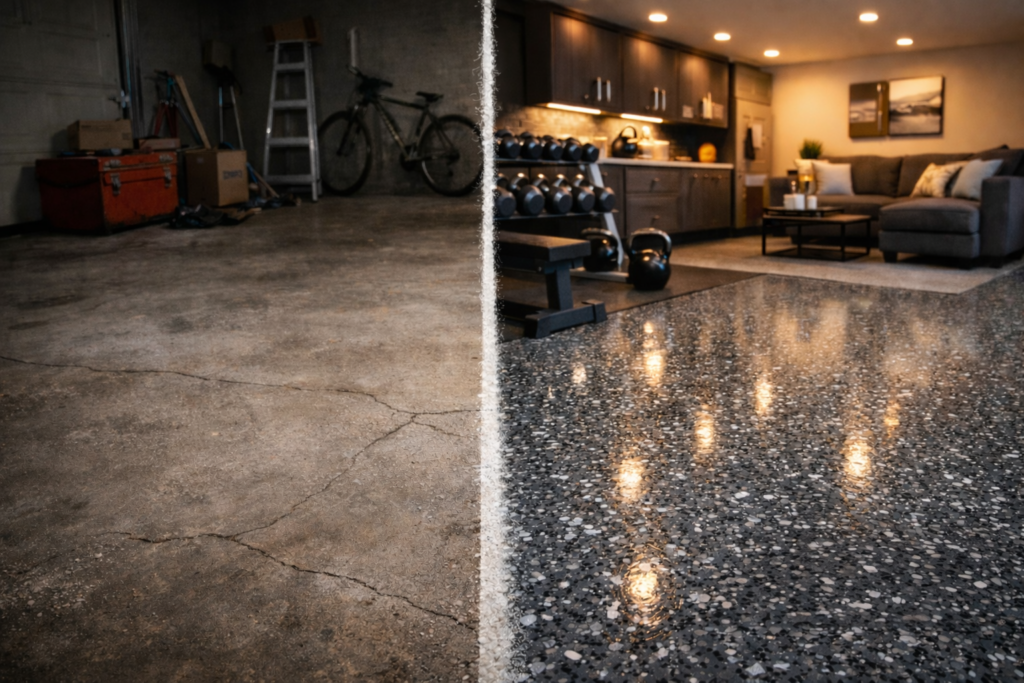
When homeowners decide to convert a garage into something more—a gym, a workshop, a creative studio, a hybrid office, even an entertaining space—the conversation often starts with lighting, insulation, or the garage door.
But the transformation truly begins underfoot.
The floor is the largest continuous surface in the garage space. It absorbs impact, regulates temperature, reflects light, and sets the emotional tone of the room. If the garage door is the portal, the flooring is the foundation that makes the lifestyle sustainable.
Not all garage flooring options, however, are created equal.
Below, we break down the most common garage flooring solutions—especially durable, design-grade systems such as epoxy and polyaspartic coatings—with an eye on cost, problems, comparisons, reviews/real-world outcomes, and best-for recommendations.
Before You Choose: What Is Your Garage Becoming?
Flooring decisions should always follow intended usage. A garage gym demands something different than a hobby woodshop. A social lounge requires a different feel than a high-storage utility space.
Ask yourself first:
- Will this space experience heavy impact (weights, equipment)?
- Will vehicles still enter occasionally?
- Does moisture intrusion occur seasonally?
- Is comfort underfoot important for long daily use?
- Does the floor need to visually elevate the space?
Only then should you evaluate materials.
Option 1: Interlocking Tiles (PVC or Polypropylene)
What They Are
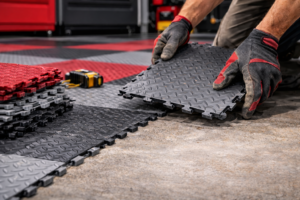
Modular tile systems that click together and float over the concrete slab.
Estimated Cost Range
- DIY materials: $3–$7 per square foot
- Installed: $6–$10 per square foot
For a 400 sq. ft. garage:
- $1,200–$4,000 depending on material and labor.
Pros
- Quick installation
- Replaceable sections
- Good airflow beneath tiles
- Comfortable underfoot
Problems & Drawbacks
- Can shift or separate over time
- Dirt and moisture can collect underneath
- Not seamless
- Lower-end versions fade or crack
Best For
- Temporary upgrades
- DIY-focused homeowners
- Light-use garages or hobby areas
 A1 Pro Insight:
While cost-effective, interlocking floor tiles are not ideal for high-end lifestyle conversions where design continuity matters.
Interlocking tiles are best for homeowners who want flexibility. If you anticipate changing layouts, replacing damaged sections, or installing the floor yourself, this option offers adaptability. However, it is not seamless—and that matters in high-design conversions.
Option 2: Roll-Out Vinyl Flooring
What It Is
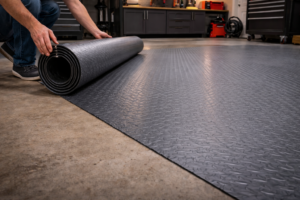
Large, continuous vinyl sheets rolled across the slab.
Estimated Cost
- Materials: $2–$5 per sq. ft.
- Installed: $4–$8 per sq. ft.
Pros
- Quick cosmetic improvement
- Hides minor slab imperfections
- Comfortable surface
Problems
- Susceptible to moisture trapping
- Can bubble or shift
- Limited lifespan compared to coatings
Best For
- Budget refreshes
- Transitional spaces
- Low-impact usage
A1 Pro Insight: Budget vs Longevity
Roll-out vinyl is primarily cosmetic. It improves appearance quickly but is not engineered for long-term, high-impact lifestyle conversions. It can trap moisture if the slab is not properly evaluated.
Option 3: Epoxy Coatings
Now, we enter serious transformation territory.
What It Is
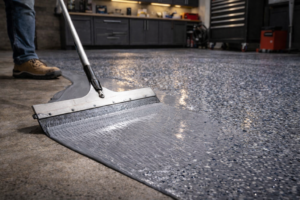
A multi-layer resin system applied directly to prepared concrete, chemically bonding to the slab.
Estimated Cost:
- Professional installation: $4–$8 per sq. ft.
- Premium decorative systems: $6–$10 per sq. ft.
For a 400 sq. ft. garage:
- $1,600–$4,000 typical range.
What Drives this Cost?
- Surface preparation (grinding vs acid etching)
- Crack repair
- Decorative flake systems
- Moisture mitigation layers
A1 Pro Insight: What Determines Epoxy Pricing
The real cost driver is surface preparation. Proper diamond grinding, crack repair, and moisture testing determine whether the floor lasts 2 years—or 10+. Lower bids often cut corners on prep work.
Pros
- Seamless finish
- High durability
- Chemical and stain resistant
- Dramatic visual upgrade
- Easy to clean
Real-World Outcomes (Reviews & Durability)
When professionally installed with proper surface grinding, epoxy floors often last 5–10+ years before noticeable wear. In moderate-use lifestyle garages (gyms, offices, lounges), lifespan can extend even longer.
However, longevity is heavily dependent on installation quality.
Common Problems
- Moisture failure: If vapor transmission from the slab isn’t addressed, bubbling or peeling can occur.
- Hot tire pickup: In lower-grade systems, vehicle tires can lift coating.
- UV yellowing: Standard epoxy can discolor in sunlight over time.
A1 Pro Insight: The #1 Epoxy Failure Point
Moisture vapor transmission is the leading cause of peeling and bubbling. A professional installer should conduct moisture testing and, if needed, apply a moisture-mitigating primer. Skipping this step is the most common mistake homeowners make.
This is where polyaspartic systems enter the conversation.
Option 4: Polyaspartic Floor Coatings (Premium Tier)
What It Is
An advanced coating technology that cures faster and offers higher flexibility and UV stability than traditional epoxy.
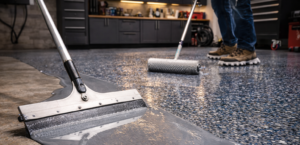
Estimated Cost:
- Installed: $6–$12 per sq. ft.
- High-end decorative systems may reach $14 per sq. ft.
For 400 sq. ft.:
- $2,400–$5,600
A1 Pro Insight:
Polyaspartic floor coating is a premium investment due to its 15-25 year lifespan, UV stability, and rapid return to service (walkable in 4-6 hours). It offers extreme abrasion and chemical resistance, cures quickly even at low temperatures, and can be applied in thick, single coats.
Comparisons: Epoxy vs. Polyaspartic (Big Five: Comparisons)
| Feature | Epoxy | Polyaspartic |
| Cure Time | 1–3 days | Often 1 day |
| UV Stability | Moderate | Excellent |
| Flexibility | Lower | Higher |
| Moisture Tolerance | Moderate | Higher |
| Cost | Lower | Higher |
Polyaspartic systems:
- Resist yellowing
- Perform better in fluctuating temperatures
- Are less brittle
- Often include thicker, more decorative flake layers
Real-World Experience
In converted garage gyms or multi-use lifestyle spaces, polyaspartic systems:
- Maintain gloss longer
- Resist impact from dropped equipment
- Handle temperature swings from open garage doors better
- Clean easily after heavy use
Many professional installers now recommend polyaspartic systems for performance-focused garage conversions where daily use is expected.
Design-Grade Finishes: Where Performance Meets Aesthetic
A garage conversion isn’t just about durability. It’s about atmosphere.
Decorative flake systems, metallic epoxy finishes, and matte polyaspartic topcoats allow homeowners to:
- Brighten the space through light reflectivity
- Coordinate flooring with cabinetry or wall color
- Create a visual break between workout zones and lounge zones
- Achieve a showroom-quality finish
A well-executed coating makes the garage feel intentional, not improvised.
A1 Pro Insight: Light Matters More Than You Think
High-reflectivity flooring can brighten a garage by 20–30%, reducing the need for additional lighting. In lifestyle conversions, this affects both mood and energy efficiency.
What About Comfort?
Concrete coatings are durable—but they’re still concrete underneath.
For gym spaces:
- Add rubber stall mats over coated floors for impact zones.
- Use modular gym tiles in lifting areas.
For office or lounge conversions:
- Incorporate area rugs for warmth and acoustics.
The key is layering. The coating provides durability and moisture protection; softer materials provide comfort.
A1 Pro Insight: The True Cost of DIY
DIY epoxy kits often cost $1.50–$3 per sq. ft. upfront. However, if failure occurs within 1–3 years, professional removal and reinstallation can double total lifetime cost. For performance spaces, professional installation is typically more economical long-term.
Mistakes to Avoid
- Skipping Surface Preparation
Grinding the slab is non-negotiable. Acid etching is rarely sufficient for long-term adhesion.
- Ignoring Moisture Testing
Moisture vapor transmission is the #1 cause of coating failure.
- DIY on Performance Spaces
DIY epoxy kits often:
- Lack proper bonding strength
- Peel within 1–3 years
- Do not include moisture mitigation layers
DIY kits are often cheaper upfront, but can be more expensive long term if the work must be replaced in the future.
A1’s Best-For Recommendations
Budget Refresh, Low Use
- Roll-out vinyl or interlocking tiles
DIY Upgrade, Moderate Use
- Entry-level epoxy kit (understanding lifespan tradeoffs)
Gym Conversion with Daily Use
- Professionally installed epoxy with flake system
- Polyaspartic preferred for higher durability
Hybrid Lounge + Gym + Entertaining Space
- Polyaspartic flake system with matte finish
Garage That Still Houses Vehicles
- Polyaspartic with high abrasion resistance and UV stability
How Flooring Connects to the Garage Door
Here’s what many homeowners miss:
If you are investing in premium flooring but keeping an uninsulated, draft-prone, noisy garage door, the space will never fully perform.
Temperature swings affect:
- Coating longevity
- Comfort underfoot
- Moisture control
- Daily usability
A high-performance insulated garage door:
- Stabilizes interior climate
- Reduces condensation risk
- Protects flooring investment
- Enhances sound control for fitness or work
A1 Pro Insight: Flooring and the Garage Door Work Together
Premium flooring performs best in a stable environment. An insulated, properly sealed garage door reduces moisture swings, condensation, and extreme temperature shifts—all of which extend coating lifespan. Investing in one without evaluating the other leaves performance on the table.
The flooring makes the space beautiful and durable. The garage door makes it livable year-round. They must work together.
Final Thought: Flooring Is Not (Just) Cosmetic
In a converted garage, flooring is not a decorative afterthought. It is a structural decision that affects durability, maintenance, comfort, and long-term value.
Done correctly, it:
- Elevates the entire aesthetic
- Protects the slab
- Supports daily activity
- Enhances resale appeal
- Extends the lifespan of your entire garage investment
Done poorly, it becomes the first visible failure.
When the garage becomes a real part of how you live—train, work, create, gather—the floor stops being concrete. It becomes a platform.
And platforms deserve performance.