



Blog | GARAGE DOORS
Repair or Replace Your Garage Door? The Honest Cost Breakdown
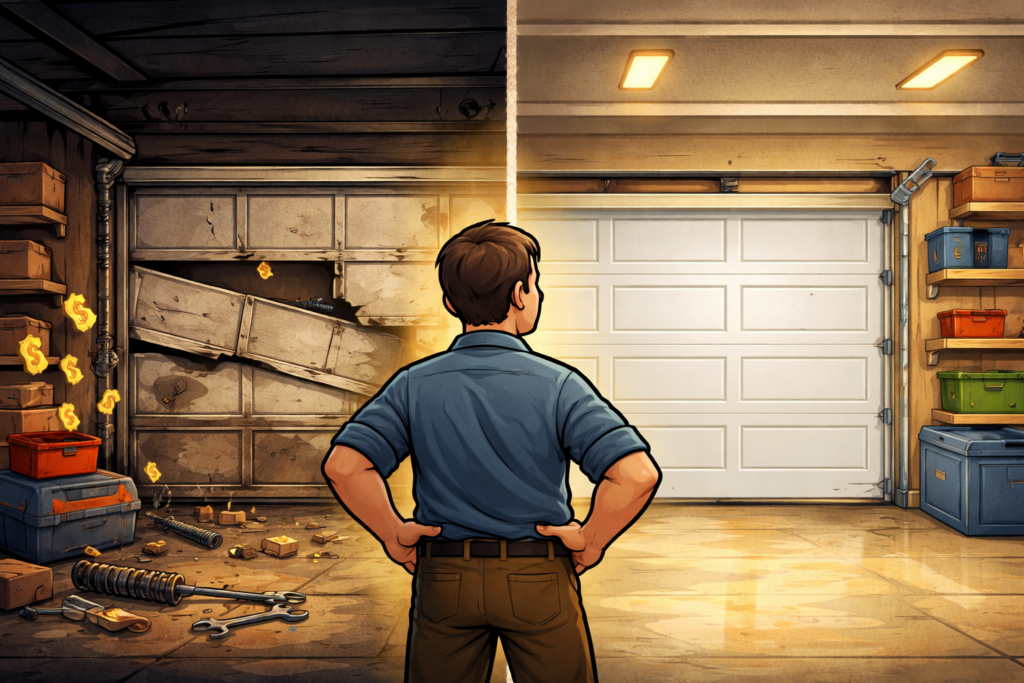
The Answers to Your Questions (Before You Read)
- Frequent repairs = wasted money over time
- If your door keeps breaking, replacement is smarter
- Old or low-quality doors fail faster and cost more long-term
- A new door improves safety, reliability, and home value
- Good doors can be repaired, but bad ones should not be saved
- If you’re already thinking about replacing it… it’s probably time
Should You Repair or Replace Your Garage Door?
Do you find yourself fixing your garage door over and over? Have you been wondering if replacing it is just too expensive?
Here’s the truth most garage door companies won’t say clearly: You can waste thousands of dollars over the years trying to “keep your garage door alive.”
In this guide, the experts at A1 give you the straight answers on the pros and cons of repairing your garage door versus replacing it with a new one. By the end, you’ll learn when repair makes sense, when replacement is smarter, and how to avoid wasting money.
The Direct Answer: When to Repair vs Replace
At A1 Garage Door and Service, we’ve helped thousands of customers over the years answer this question. No two homeowners are alike, but here are a few A1-approved rules of thumb.
Repair your garage door if:
- The door is under 10–12 years old.
- The structure is still solid.
- Issues are small (springs, rollers, opener).
- It’s a high-quality insulated or steel-back door.
Replace your garage door if:
- You’re calling for repairs multiple times a year.
- Panels are damaged, sagging, or breaking.
- The door is outdated or low quality.
- Repairs are adding up fast.
- The door no longer fits your lifestyle.
 A1 Pro Tip:
If you keep fixing your door every year or so, you’re likely wasting money and delaying an inevitable replacement.
What Are the Hidden Costs of “Cheap Garage Door Repairs?”
Repairs to your garage doors feel cheaper than full replacements in the moment. In fact, repairs are cheaper in almost all cases.
But here’s what can actually happen when you opt for the cheap repair route:
- $200 repair turns into multiple service calls.
- 2–3 visits per year = $600–$1,000 annually.
- After a few years… you still need a new door.
That means you paid for both repairs and replacement.
A1 Pro Insight:
At A1, we’ve helped many homeowners over the years understand and overcome this costly mistake.
The “Kicking the Can” Problem
Many homeowners delay replacement. As the saying goes, they’re simply kicking the can down the road, putting off the purchase of a new garage door and opting instead for small, cheap repairs.
Here’s what “kicking the can” leads to:
- Doors getting stuck or going sideways
- Panels collapsing or breaking
- Unsafe operation
- Sudden total failure
A1 Real Customer Example:
A homeowner delayed replacement for years. The door eventually became “completely sideways” and beyond repair. After sinking enough money into repairs over the years that amounted to a full replacement, she admitted, “I should have replaced the door years ago.”
How Much Does Quality Matter in a New Garage Door (More Than You Think)
Not all garage doors are equal.
Builder-grade garage doors are made with thinner materials and lower-quality components, designed to look good at a low cost but wear out faster. Medium to high-grade doors use stronger materials, better insulation, and more durable parts, making them quieter, longer-lasting, and more reliable over time.
Builder-Grade Doors
- Thin materials
- Short lifespan
- Lower cost upfront
- Fail faster
Mid- to High-Grade Doors
- Insulated
- Stronger panels
- Quieter operation
- Longer lifespan
A1 Pro Insight:
Because they are of a lower quality, builder-grade doors have a tendency to break down more often than higher quality doors. Cheap doors can therefore cost homeowners more money over time.
When Does Repair Still Make Sense?
Not every garage door needs replacement when it fails.
Repair is the right move if:
- You have a steel-back insulated door.
- The issue is mechanical, not structural.
- The door still fits your needs.
A1 Pro Insight:
Steel back-insulated doors are conducive to repair because they have a strong, reinforced structure that holds up over time, even when parts wear out. Since the core door remains solid, technicians can replace individual components like springs, rollers, or hardware without needing to replace the entire door.
Warning Signs It’s Time to Replace Your Garage Door
Watch for these signals. Your garage door is trying to tell you something:
- Loud operation
- Frequent breakdowns
- Visible damage or bending
- Poor insulation
- Mismatched or patched parts
- DIY fixes (duct tape, makeshift repairs)
A1 True Customer Story:
An A1 technician reported that he showed up to a job and the customer’s door had a barbecue spatula helping maintain its structural integrity. Talk about a “Band-Aid” fix. Good thing the customer decided to replace the door before she was cooked.
ROI: Does a New Garage Door Pay Off?
Yes. It can, and in more ways than one.
Benefits of Garage Door Replacement:
- Better safety
- Quiet operation
- Improved curb appeal
- Higher home value
- Smart features and convenience
Even if you’re selling your home:
Buyers notice garage doors. When the garage door is in disarray, they wonder what else on the home has not been maintained.
What Common Mistakes Homeowners Do Make?
Over the years, we at A1 have seen just about every mistake a homeowner can make with a garage door. Here a few of the popular ones we wish weren’t so popular.
- Choosing the cheapest option
Cheap now often means expensive later
- Ignoring lifestyle needs
Is your garage also a workout gym? Then your door’s ability to maintain heat matters. Is it for family use? Then the door’s durability matters.
- The technician does not ask questions
A good garage door technician should ask you about:
- Usage
- Goals
- Budget
- Timeline
- Trusting pushy sales tactics
Bad salespeople:
- Don’t ask questions
- Push replacement without context
Good ones:
- Educate first
- Offer options
A1 Pro Insight:
A good technician should provide you with plenty of options based on the answers to their questions, especially if you are on the fence about repairing or replacing your garage door.
DIY vs Professional Advice
DIY tasks homeowners can safely perform:
- Lubrication
- Visual checks
Call a Pro for:
- Structural issues
- Springs or cables
- Replacement decisions
A1 Pro Safety Tip:
Garage doors are heavy and can be very dangerous. These items require a trained professional.
FAQs about Whether to Replace or Repair a Garage Door
- How do I know if I should repair or replace my garage door?
If repairs are frequent or costly, replacement is usually the better long-term choice.
- How many repairs are too many?
More than one or two repairs per year is a strong sign that replacement makes more sense.
- Is it cheaper to repair a garage door?
Short-term yes, but repeated repairs often cost more than replacement over time.
- How long should a garage door last?
Most doors last 15–30 years, depending on quality and maintenance.
- Can all garage doors be repaired?
No. Structural damage or low-quality doors often cannot be repaired effectively.
- Does a new garage door increase home value?
Yes. It improves curb appeal and is one of the highest ROI home upgrades.
In One Minute (Quick Recap)
- Repairs can become a money trap.
- Replacement solves long-term problems.
- Quality doors are worth the investment.
- Cheap doors fail faster.
- If you’re thinking about replacing… you likely should.
If you’re unsure, don’t guess.
Have a professional inspect your door and give honest advice. Schedule an inspection with A1 Garage Door Service.
Want to learn more about this topic from the A1 experts? Watch A1’s podcast, “The Garage Authority,” below: