



Blog | GARAGE DOORS
Garage Door Problems: Signs Your Door May Be Unsafe
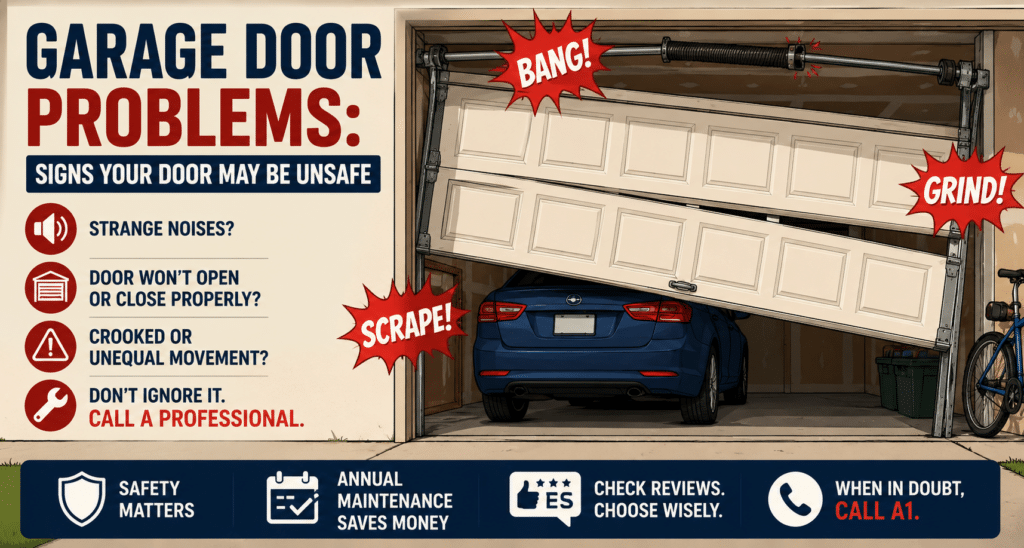
Quick Answers Before You Read. Here is the short version.
- Most common garage door problem: Broken springs.
- Second common issue: Opener failure or a bad logic board.
- Biggest homeowner mistake: Keep using the door after something sounds wrong.
- Top warning signs: Popping, banging, scraping, grinding, groaning, or crooked movement.
- Safest DIY task: Lubricating moving parts.
- Dangerous DIY tasks: Springs, cables, struts, major hardware, and balance work.
- Best maintenance habit: Have your garage door checked once a year.
- Best company red flag check: Look at both review quality and review count.
- Best rule: When your door makes you question safety, call a professional.
Is your garage door making a strange noise? Does it open a few inches, stop, then go back down?
That is not something to ignore.
At A1 Garage Door Service, we often remind homeowners that a garage door is the biggest moving object in the home. It is not just a door. It is a moving wall with springs, cables, rollers, tracks, hinges, and an opener.
When it works, you barely think about it. When it fails, it can trap your car, damage property, or hurt someone. So what should you watch for? What can you safely fix yourself? And when should you call A1?
Let’s break it down.
What Are the Most Common Garage Door Problems?
The most common garage door problem is a broken spring.
When it snaps, a broken spring often sounds like a loud bang. Many homeowners think something hit the garage. Then they try the door the next morning. It opens an inch or two, stops, and goes back down.
That is because, in a garage door system, the spring does the heavy lifting. The opener is not meant to lift the full weight of the door. It only guides the door. The springs provide the counterbalance.
A standard non-insulated garage door can weigh around 170 to 190 pounds. Without the spring system, that weight becomes unsafe fast.
The second common problem is opener failure.
This may show up as:
- Clicking
- Humming
- Blinking lights
- No movement
- A grinding sound
- A chain slipping sound
 A1 Pro Tip:
In simple terms, springs are the system’s muscle. The opener is the brain. If either one fails, your garage door may stop working.
The Biggest Mistake Homeowners Make
The biggest mistake homeowners make is simple to avoid. Homeowners keep using a door that needs service or repair instead of calling a reputable garage door company to fix or replace it.
If your door sounds wrong, moves crooked, or struggles, do not keep pressing the button. That usually makes the problem worse.
A crooked door can come out of the track. A weak spring can put too much strain on the opener. A noisy roller or hinge can become a broken part.
What starts as a small repair can become a much larger one.
Warning Signs Your Garage Door May Be About to Fail
Call A1 Garage Door Service if you notice any of these signs:
- Popping sounds
- Loud banging
- Scraping
- High-pitched groaning
- Grinding from the opener
- Chain slipping sounds
- Door opening crooked
- Door stopping halfway
- Door feeling heavier than normal
- Opener straining
Any new sound you hear your garage door making matters. Garage doors do not usually “fix themselves.” If something sounds different, something has changed…usually for the worse.
An A1 Real Customer Story: When a Door Lands Where It Shouldn’t
A1 Garage Door Service has seen garage doors fall onto cars, bikes, and family belongings.
In one real case, a heavy wood door failed and came down onto a vehicle. The homeowner had noticed rough operation before it happened. The door sounded off. It moved poorly. But the problem was pushed off.
By the time help was called, the door was no longer just noisy. It had failed.
No one was hurt, but the damage was costly.
That is the point homeowners should remember. The best time to call is before the door falls, not after.
A1 Pro Tip:
A service visit may cost money. But it can give you peace of mind. It can also catch unsafe issues early.
What Garage Door Maintenance Can Homeowners Do?
The safest DIY garage door maintenance task is lubrication.
You can lubricate moving parts such as:
- Springs
- Roller bearings
- Hinges
- Other moving metal parts
A1 recommends using a good garage door lubricant. Petroleum-based lubricants tend to stay longer and penetrate well. Silicone can work, but it may not last as long.
Do not overdo it. Apply lubricant where parts move. Keep it clean.
The International Door Association also says homeowners can do some safety and maintenance tasks, but should hire a trained technician when they are not comfortable.
What Garage Door Repairs Should Not Be DIY?
Some DIY jobs are fine around the house. Garage door springs are different.
Do not try to repair:
- Springs
- Cables
- Bottom brackets
- Major hardware
- Door balance
- Track problems
- Makeshift struts
- Structural damage
These parts carry high tension. Mistakes can cause serious injury.
A1 has seen technicians hurt by small mistakes. That should tell homeowners something important.
A1 Pro Safety Tip:
If trained people treat garage doors with caution, homeowners should too.
Why DIY Insulation Can Cause Problems
Many homeowners try to insulate an existing garage door. Some use spray foam. Some add fiberglass insulation. Some use cables or homemade supports to hold material in place.
The problem is weight.
When you add weight, you change the door. The springs may no longer be balanced for that door. The opener may strain. Panels may sag.
If you want an insulated door, the better option is to buy an insulated garage door made for that purpose.
That may mean saving, financing, or planning ahead. But it is safer than changing the structure of a door that was not built for it.
How Often Should a Garage Door Be Serviced?
A1 Garage Door Service recommends a professional inspection once a year.
During a yearly checkup, a technician can:
- Inspect the full system
- Lubricate moving parts
- Check the door balance
- Weigh the door if needed
- Look for worn hardware
- Make needed adjustments
- Check opener strain
- Confirm safe operation
Metal gets tired. Parts loosen. Homes settle. Springs wear down. A yearly inspection helps keep the door safe, balanced, and reliable.
Cost Factors: Why a Checkup Can Save Money
Garage door repair costs depend on the problem. A small adjustment may be simple. A broken spring, damaged opener, or fallen door can cost much more.
The better question is not, “Can I avoid a service call?”
The better question is, “What happens if I wait?”
Cost factors include:
- Door size
- Door weight
- Spring type
- Opener condition
- Track damage
- Panel damage
- Emergency timing
- Safety issues
- Parts needed
A1 Pro Tip:
A checkup can help prevent bigger bills later.
How to Choose a Garage Door Company
Before hiring a garage door company, look at its reputation. Do not only look at the star rating. Look at the number of reviews, too.
A company with a small number of good reviews may be fine. Everyone starts somewhere. But hundreds or thousands of strong reviews show a repeatable process.
Look for:
- Strong review count
- Clear communication
- Professional inspection process
- Safety-first advice
- No pressure tactics
- Clear explanations
- Proper training
A good company should help you understand the problem. They should not just sell you something.
Safety Standards Homeowners Should Know
Modern garage door openers include important safety features. The U.S. Consumer Product Safety Commission announced updated safety rules for automatic residential garage door openers manufactured on or after January 1, 1993. These rules included entrapment protection requirements.
That matters because older openers may not have the same safety setup.
If your opener is very old, ask A1 to inspect it. Safety sensors and auto-reverse features are not “extras.” They help protect people, pets, and property.
DIY vs. Professional: The Simple Rule
Here is the easiest way to decide.
Safe DIY:
- Light lubrication
- Watching for strange sounds
- Keeping tracks clear
- Checking sensor alignment visually
- Calling early when something changes
Call A1:
- Broken springs
- Cable issues
- Door off track
- Crooked movement
- Loud bang
- Opener grinding
- Door feels heavy
- Failed hardware
- DIY insulation problems
- Anything that feels unsafe
If the door makes you wonder, call.
Local Relevance
In hot markets like Houston, Phoenix, and other warm areas, garage doors can take a beating. Heat, humidity, and daily use all wear on parts.
In colder markets, metal parts can also strain during winter.
No matter where you live, yearly service helps catch small problems early.
In One Minute
- Broken springs are the top garage door problem.
- A loud bang often means a spring broke.
- Your opener guides the door. It should not lift all the weight.
- Strange noises are warning signs.
- Do not keep pressing the button if the door moves wrong.
- Lubrication is the safest DIY task.
- Springs, cables, and balance work should be left to pros.
- DIY insulation can damage the door.
- Annual maintenance can prevent bigger repairs.
- Choose a company with strong, real customer reviews.
FAQs about Garage Door Problems
Why does my garage door open a few inches and stop?
This often means the spring is broken or the door is too heavy for the opener. Stop using it and call A1.
What does a broken garage door spring sound like?
It often sounds like a loud bang. Some homeowners describe it as a gunshot in the garage.
Can I replace my own garage door spring?
No. Springs are under high tension and can be dangerous. Call a trained professional.
What garage door maintenance can I do myself?
You can lubricate moving parts and watch for changes. Leave major repairs to a professional.
How often should I service my garage door?
A1 recommends a professional inspection once a year.
Should I add insulation to my current garage door?
Be careful. Adding insulation changes the weight and balance. A factory-insulated door is usually the better choice.
Not sure if your garage door is safe? Schedule a garage door inspection with A1 Garage Door Service today.