



Blog | GARAGE DOORS
What Is a Garage Door Torsion System? (Springs, Drums, Bearings Explained for Homeowners)
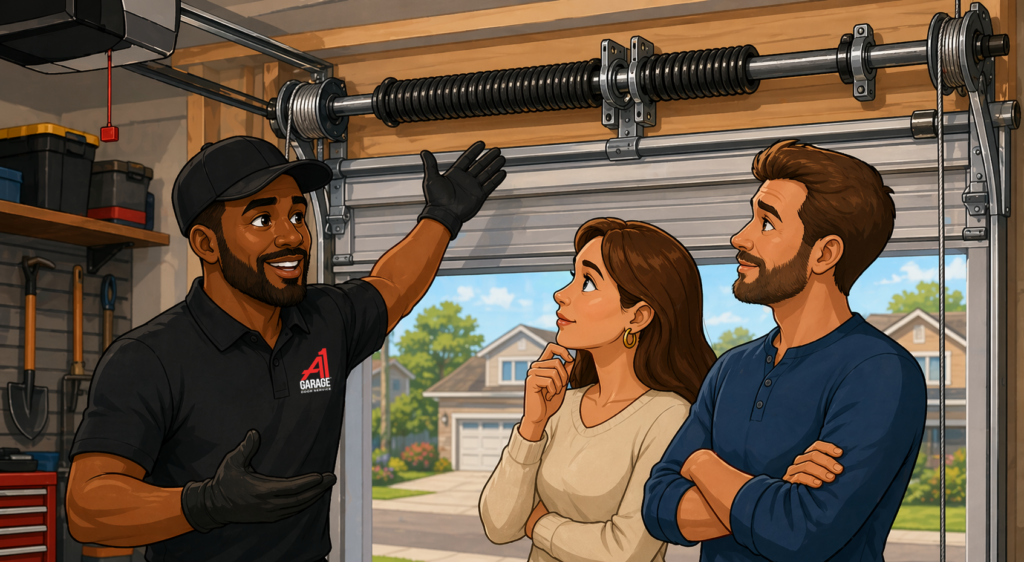
If you only have one minute, here’s what A1 Garage Door Service wants homeowners to know:
- Your torsion system is what lifts the weight of your garage door. Without it, your door would be dangerously heavy.
- The key parts are the springs, drums, torsion tube, and bearing plates. They all work together, and if one part fails, the whole system is at risk.
- A level torsion line matters more than most homeowners realize. If the tube is “smiling” or “frowning,” that usually means extra wear, poor installation, or a developing failure.
- Bearings and drums can quietly wear out over time. Black dust, metal shavings, scraping sounds, slipping cables, or uneven movement are all warning signs.
- Small repair costs can prevent major replacement costs. A bearing or drum repair may cost a fraction of what you’ll spend if the door comes off track or the system damages the door.
- Wrong parts cause real problems. Builder-grade parts, plastic bushings, incorrect drums, or the wrong torsion tube can shorten the life of the entire system.
- Homeowners should inspect visually, not repair themselves. Torsion systems are under extreme tension and should only be adjusted or repaired by trained professionals.
- Two quick things you can check: make sure the torsion line looks level, and make sure the center bearing plate appears securely mounted.
What actually lifts your garage door every time you press the opener?
Most homeowners think it is the motor, but the real heavy lifting happens in the torsion system above the door.
At A1 Garage Door Service, we often tell homeowners the same thing: when one part in that system starts to fail, the rest of the door begins to suffer with it.
In this guide, we’ll break down how the torsion system works, what each part does, the warning signs to watch for, and why catching a small issue early can help you avoid a much bigger repair later.
You’ll learn:
- What a garage door torsion system does
- What each major part is responsible for
- Why level alignment matters
- The warning signs of wear
- How small neglected issues become major repairs
- What you can safely inspect as a homeowner
What Is a Garage Door Torsion System?
A garage door torsion system is the lifting system mounted above your garage door.
It uses tension-loaded springs and supporting hardware to counterbalance the weight of the door, making a heavy garage door feel light enough to open and close smoothly.
At A1 Garage Door Service, we often explain it this way:
The torsion system is the muscle of the garage door. It is what makes a door weighing well over 100 pounds move in a controlled, balanced way.
 A1 Pro Insight:
Without a properly functioning torsion system, the opener is forced to do too much, the door can become uneven, and the entire system can become unsafe.
The Main Parts of a Garage Door Torsion System
A torsion system is only as healthy as the parts working inside it.
- Torsion Springs
These are the tightly wound springs mounted above the door. Their job is to store and release energy so the door can lift and lower with control.
Think of springs as the counterweight system. They make the door manageable.
- Drums
Garage door drums sit at the ends of the torsion system and hold the lift cables. As the door moves, the drums wind and unwind the cables.
If the drums wear, crack, slip, or grind, cable problems usually follow.
- Torsion Tube
The torsion tube, sometimes called the torsion shaft, runs across the top of the door and connects the system together.
At A1, we often compare it to the spinal column of the torsion line. It needs to stay straight and properly supported so the entire system can rotate in unison.
- End Bearing Plates and Center Bearing Plate
These parts support the torsion tube and allow it to rotate properly.
When the bearings inside these plates are in good shape, the system turns smoothly. When they are worn, seized, or poorly aligned, the tube can grind, chatter, and eventually fail.
Why Every Part Matters
A garage door torsion system is not a “replace one spring and ignore the rest” type of system. All the parts affect one another.
At A1 Garage Door Service, we see it like the human body or a car engine:
- If one part misfires, the whole system suffers.
- If one part drags, other parts absorb the stress.
- If one part seizes, the system can stop suddenly.
That is why inspecting only the obvious problem often misses the real cause.
Why a Level Torsion Line Matters
One of the most important things a technician checks is whether the torsion line is level across the opening. If the tube is not straight, the system experiences uneven loading and increased wear.
In practical terms, that means:
- More stress on bearings
- More friction on drums
- More strain on cables
- More long-term wear on the opener and door
A1 Pro Insight:
At A1, technicians often describe a bad torsion line as “smiling” or “frowning.” If the tube curves up or down instead of sitting level, that is a warning sign worth taking seriously.
Common Bearing Problems Homeowners Should Never Ignore
Bearings do not get much attention from homeowners, but they are critical to the health of the torsion system.
Their job is to help the torsion tube rotate smoothly. If they begin to fail, they can cause noise, metal wear, misalignment, and eventually a major system malfunction.
Warning signs of bearing trouble:
- Grinding or screeching noises
- Black dust or metal shavings
- Visible wear around the tube
- Chatter or rough movement
- A seized bearing that no longer rotates correctly
A1 Pro Insight:
At A1 Garage Door Service, we’ve seen situations where a relatively small bearing issue turned into a much larger repair because the system kept operating until the torsion tube stopped rotating properly.
That is the kind of small issue that can become expensive fast.
A Common Homeowner Mistake: Over-Lubricating Bearings
Many homeowners assume more lubricant is always better. It is not.
Too much lubricant can actually damage certain bearings by displacing the internal grease structure that helps them function correctly. Once a bearing starts rattling, chattering, or breaking down internally, adding more lubricant is not a fix.
That is one reason A1 recommends inspection over guessing.
A1 Pro Tip:
A small amount of proper maintenance is helpful. Flooding parts with lubricant is not.
Garage Door Drums: Small Part, Big Risk
Drums are another overlooked part of the torsion system that can create serious problems.
They hold the cables in place and control cable movement as the door opens and closes. If the drum is worn or the wrong drum is installed, the system can become jerky, uneven, or unstable.
What A1 looks for on garage door drums:
- Outside wear and tear
- Cracks or scarring
- Damage on the inside of the drum
- Slipping set screws
- Cable alignment problems
- Signs the drum has been grinding into the surrounding parts
This is one of those issues homeowners often do not notice until the door becomes visibly crooked or the cable comes off.
The Hidden Problem: Wrong Parts on the Wrong Door
Not every garage door should use the same parts. Different doors require different components based on size, weight, and application.
That includes:
- The correct drum
- The correct torsion tube gauge
- The right center bearing setup
- Properly matched springs
When the wrong part is installed, the door may still operate for a while. However, “working” and “working correctly” are not the same thing.
At A1 Garage Door Service, we often find issues caused by:
- Builder-grade components
- Incorrect replacement parts
- Tubes that are too light for the door
- Overtightened set screws
- Plastic components where steel should be used
These shortcuts may save money upfront, but they usually reduce lifespan and increase risk.
Builder-Grade Parts vs. Better Long-Term Parts
Builder-grade parts
Builder-grade parts are common on newer homes. They often meet minimum standards, but they are not always designed for long-term durability.
Higher-quality replacement parts
A better part may cost more upfront, but it often offers:
- Better structural integrity
- Longer lifespan
- Better support for heavier doors
- Fewer service issues over time
A1 Pro Tip:
At A1 Garage Door Service, we often recommend steel components in critical areas because these parts support a heavy moving door over your vehicle, your belongings, and sometimes above the path your family walks through every day.
Why Plastic Components Up Top Are a Bad Idea
Homeowners must understand the problems plastic bushings and other lightweight components in critical torsion-system positions can create.
If a part is helping support and stabilize a heavy garage door system, durability matters.
A1 Pro Recommendation:
A1 generally recommends more robust materials in these high-stress locations because lightweight or lower-grade parts can wear faster, flex more, and create alignment issues that affect the entire system.
What Happens When a Torsion Tube Is Damaged?
A damaged torsion tube is not a cosmetic inconvenience. It is a structural problem.
A tube can be damaged by:
- Overtightened set screws
- Slipping drums
- Gouging from wear
- Punctures or deep indentations
- Ongoing grinding from failed bearings
Once the structural integrity of the tube is compromised, the risk increases significantly.
A1 Pro Safety Tip:
At A1 Garage Door Service, this is treated as a serious safety concern because the tube helps control a system carrying substantial door weight.
Cost: Small Repair vs. Big Failure
What costs less?
Preventive repair almost always costs less than a full system failure.
A relatively small repair to a drum, bearing, or support component can often prevent:
- A door off track
- A jammed system
- Damage to the opener
- Bent hardware
- A damaged door
- In some cases, full door replacement
The real cost is not just the repair. It is the cost of ignoring the repair.
A1 Pro Insight:
At A1, we’ve seen homeowners avoid a modest fix only to face a much bigger bill later when the entire door system was damaged.
Comparison: Visual Inspection vs. DIY Repair
What homeowners can do
Homeowners can safely do a visual check for obvious signs of trouble.
What homeowners should not do
Homeowners should not attempt to loosen, adjust, or replace torsion system parts themselves.
Why?
Because these parts are connected to:
- Tension-loaded springs
- Heavy door weight
- Rotating hardware
- High-force cable systems
A1 Pro Safety Tip:
Regular readers of these guides have heard this often. Garage door springs are under tremendous tension and can cause serious injury if they snap. A1 Garage Door Service strongly recommends leaving spring repairs to trained professionals.
What Homeowners Can Safely Check
You should never take apart a torsion line yourself. But there are a few things you can visually inspect.
- Check whether the torsion line looks level
If it appears uneven, bowed, smiling, or frowning, call for inspection.
- Look at the center bearing plate
A secure center bearing plate should appear properly mounted and supported.
- Watch for black dust or metal shavings
That can be a sign of grinding or internal wear.
- Listen for scraping, screeching, or rough movement
Unusual noise is often an early warning sign.
- Look for uneven door movement
If one side looks lower, slower, or strained, stop using the door and have it inspected.
Two Simple A1 Homeowner Checks
Here are two homeowner-friendly checks inspired by the episode:
Check #1: Look for a level torsion line
Stand back and look above the door. If the line does not appear straight, that is worth a professional inspection.
Check #2: Measure from the top of the door to the bearing points
If you know how to measure carefully and safely from the ground, you can compare both sides visually and dimensionally. Any noticeable difference may indicate alignment issues.
If anything looks off, do not “test it a few more times.”
Call a professional.
What Happens If You Ignore the Warning Signs?
This is where garage door problems become more than annoying.
A neglected torsion-system problem can lead to:
- A crooked door
- A door stuck mid-cycle
- A cable slip
- A seized bearing
- A damaged torsion tube
- A door that comes off balance
- A major safety hazard
A1 Pro Safety Tip:
At A1 Garage Door Service, we want homeowners to know this: A garage door can go from “a little noisy” to “unsafe” faster than most people expect.
When to Call a Professional
Call a qualified garage door professional if you notice:
- A crooked or uneven door
- Grinding, scraping, or screeching
- Visible black dust or metal shavings
- Drums that appear worn or damaged
- Cable alignment issues
- A torsion line that appears curved or misaligned
- Deep set-screw marks, gouges, or damage on the tube
- A door that feels jerky, heavy, or unstable
At A1 Garage Door Service, our philosophy is simple:
Education first, safety always.
A homeowner should understand what is happening, why it matters, and what happens next.
Final Takeaway
If you remember only one thing from this article, remember this: Your garage door torsion system is not just “the spring.”
It is an entire lifting system made up of springs, drums, a torsion tube, and bearing supports that all need to work together correctly.
When one part wears out, the others pay the price. That is why small issues deserve attention early.
At A1 Garage Door Service, we believe informed homeowners make safer decisions, avoid unnecessary damage, and protect one of the largest moving systems in their home.
If your garage door looks uneven, sounds rough, or just doesn’t seem right, schedule a professional inspection before a small issue becomes a major repair.
FAQs about Torsion Systems
What does a torsion system do on a garage door?
It counterbalances the weight of the garage door so it can open and close safely and smoothly.
What are the main parts of a torsion system?
The main parts include the springs, drums, torsion tube, end bearing plates, and center bearing plate.
Why are garage door bearings important?
Bearings help the torsion tube rotate smoothly. If they wear out or seize, they can damage other parts and create unsafe operation.
Can I repair torsion system parts myself?
No. Torsion systems are under high tension and can be dangerous. A1 recommends visual inspection only and professional repair for any adjustments or replacements.
How do I know if my torsion line is not level?
It may look like it is “smiling” or “frowning” above the door, or the door may move unevenly. That is a good reason to schedule an inspection.
Are builder-grade garage door parts bad?
Not always, but they are often designed to meet minimum standards rather than maximize longevity. Higher-quality replacement parts can improve reliability and lifespan.