


Blog | GARAGE DOORS
Garage Door Maintenance: Is a Professional Tune-Up Worth It?
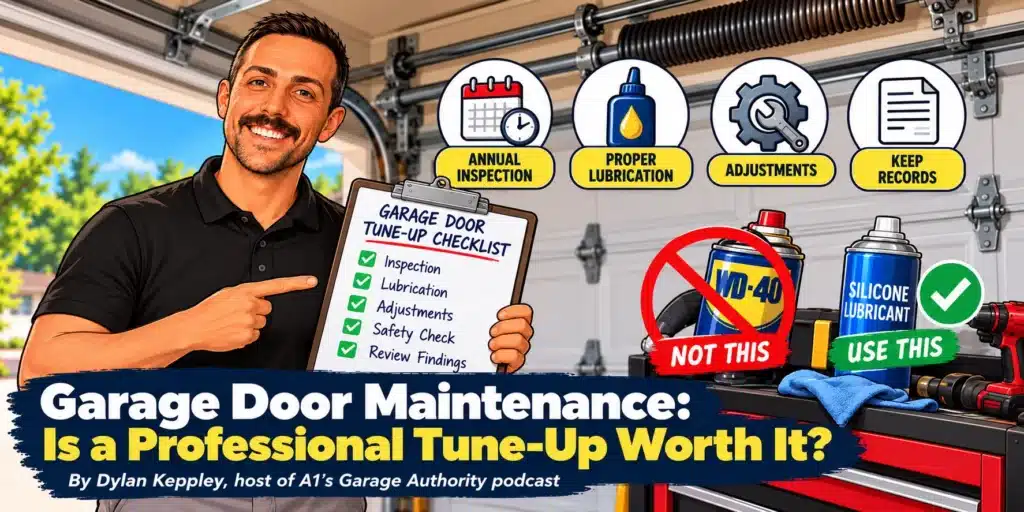
Garage Door Maintenance in One Minute
- Schedule a professional garage door inspection at least once a year.
- Match lubricants to your equipment, rather than grabbing whatever’s nearby.
- Keep repair records and warranties somewhere you can find them.
- Compare maintenance plans using written coverage, exclusions, and total costs.
Is garage door maintenance really more than lubricating a few moving parts? And is a professional tune-up worth paying for when everything on the door still works?
If we earned a nickel every time customers asked us these questions at A1 Garage Door Service, we’d be able to buy a new garage door for everyone at our company. We’ll maybe not everyone. But we answer these questions a lot.
Taking care of your garage door shouldn’t require becoming a garage door expert. So, let’s pull back the curtain and demystify the mystery.
In this article, I’ll explain common lubrication mistakes, the value of inspections, warranty records, and maintenance-plan questions. By the end, you’ll know what deserves professional attention and what to ask before spending money on a tune-up.
What Does Professional Garage Door Maintenance Include?
Professional garage door maintenance combines inspection, proper lubrication, and needed adjustments. It should also leave you with documented findings and clear next steps.
At A1, the Worry-Free Club includes an annual 151-point inspection and tune-up. But I don’t want homeowners to focus on the number alone.
What matters is whether someone actually checks your equipment and explains their findings. Ask what needs attention now and what can wait. Ask to see the pictures, too.
Here in Arizona, I compare this with scheduling annual air conditioning service. We understand why that appointment matters.
Your garage door deserves a place on that calendar, too.
I recommend a professional inspection at least once a year. Whether A1 handles it, or another trusted company does, get it checked.
What’s the Best Garage Door Lubricant?
The best garage door lubricant matches the specific part and your equipment’s instructions. There isn’t one product you should automatically spray everywhere.
Many customers say, “I can just put some WD-40 on it.”
I understand that thinking. But the product matters, and so does where you apply it. Regardless, Wd-40 is NOT the product you should be using to lubricate your garage door.
As regular readers of A1 blog articles know, WD-40 is a water displacer, not a silicone-based lubricant. While WD-$0 may seem to solve lubrication issues early, in the end, it can actually make the problem worse as it will attract dust and debris where you don’t want them.
Read the Product Label, Not Just the Brand
Original WD-40 and the brand’s specialty silicone lubricant, however, are different products. A familiar logo doesn’t mean every can contains the same formula.
The same caution applies to grease.
Chamberlain, the parent company of LiftMaster garage door openers, specifies using lithium grease for certain opener T-rails and other listed applications. It also directs owners to check their manuals for compatibility.
That doesn’t mean every rail, hinge, or roller needs the same product. Read your model’s instructions before applying anything.
More Grease Isn’t Better Maintenance
I don’t recommend covering your entire system with heavy grease. Not only can that approach collect dust, it can also leave a mess.
I’ve even heard about a homeowner using saved bacon grease. A technician told me about cleaning up that mess. It wasn’t fun. At A1, we like to keep it simple: Breakfast belongs in the kitchen, not on your garage door.
The point isn’t to embarrass anybody. It’s to show why well-meant advice needs checking before you follow it.
DIY vs. Professional Maintenance: What Should You Handle?
As a homeowner without professional garage door training, you can track service dates, organize paperwork, and review your equipment’s instructions. Those simple habits make future service easier.
For lubrication, follow the exact instructions for your garage door system. Don’t experiment just because something says “lubricant” on the label.
Call a professional when you cannot identify a part or its maintenance needs. That’s a sensible stopping point, not a failure.
Chamberlain warns homeowners against adjusting springs, cables, or related hardware themselves. Those components are under extreme tension and can cause serious injuries.
At A1, our warning against homeowners adjusting or attempting to fix garage door springs is a little more firm: Don’t do it. Ever. A snapped spring can cause serious injuries. Leave springs to the pros.
 A1 Pro Tip:
A professional visit should provide more than tools you don’t own. It should provide findings you understand and recommendations you can question.
Not sure where to start? Ask A1 about a garage door tune-up and inspection. Bring your maintenance questions so we can address them during the visit.
A Real A1 Customer Who Had Already Been Warned About His Springs
I remember arriving for an annual tune-up and finding a broken spring. During an earlier visit to this particular home, we had completed a temporary repair. The homeowner had also received a warning about his springs.
About 14 months later, the problem could no longer wait. “Can we get all this taken care of?” he asked.
He remembered the earlier recommendation and wanted the postponed work addressed. His membership in A1’s Worry-Free Club also helped reduce that bill.
That was his outcome, not a savings promise for every homeowner.
What stuck with me was the value of those earlier notes. He could see what had been flagged and understand why it mattered.
Maintenance doesn’t prevent every potential breakdown. But clear findings give you something better than a surprise recommendation. They give you information you can review before deciding what comes next.
How Much Does Garage Door Maintenance Cost?
At A1, our basic tune-up and safety inspection is usually $29.95. It includes an assessment, tightening of hardware (but not springs), and lubrication of rollers and hinges. Prices elsewhere in the industry will vary.
To gauge the total cost of garage door maintenance, we recommend breaking it into three parts: the tune-up, any repairs, and a membership.
Don’t assume paying for one automatically covers the others. A1 offers one-time maintenance and membership options, with separate terms and exclusions.
A useful price comes with a clear description of the work. Before approving anything, request an itemized quote.
Ask whether the quote covers each garage door, plus any opener maintenance. Check whether replacement parts or additional visits would cost extra.
Also ask what happens when the inspection identifies a repair need. You should understand that recommendation before approving another charge.
Compare the work included, not just the advertised price.
A lower number doesn’t tell you what someone will inspect or document. A higher number doesn’t explain itself, either. Ask for the details. You deserve a clear answer without having to guess.
Is A1’s Worry Free Club Worth It?
The Worry-Free Club may suit homeowners who value annual service and labor-warranty benefits. But a membership isn’t automatically the right purchase for everyone.
I’d compare it with booking individual visits using three steps:
- Compare written totals. Request one-time service pricing and the full membership cost.
- Check the coverage. Confirm which maintenance, parts, labor, and fees are included.
- Review the rules. Ask about scheduling, coverage start dates, renewal, and cancellation.
Then ask yourself whether you’ll use what’s included.
A homeowner who values ongoing maintenance may see a clear benefit. Another homeowner may prefer paying separately for each visit.
Neither decision should depend on pressure or vague promises.
Read the current agreement, especially the exclusions and scheduling requirements. Don’t assume everything described as “worry-free” means every future expense disappears.
For me, customer service means helping people understand what they’re buying. That includes explaining what they’re not buying.
Contact A1 Garage Door Service to schedule your garage door maintenance visit. Bring your questions. We’ll help you understand your options and the next step.
Frequently Asked Questions About Garage Door Maintenance
Can I Join the Worry Free Club After Having Repairs Completed?
Contact A1 to discuss enrollment after completed work. Have your invoice and installation date ready.
Ask when benefits begin and whether your earlier installation qualifies. Get written confirmation rather than assuming coverage applies retroactively. Current eligibility should be checked against the membership agreement.
What Should I Do if My Warranty History Isn’t Showing Up?
Check the name, phone number, and service address on the account. An old address or spelling error may lead to a different customer profile.
Your saved invoice can help A1 locate the correct history. A missing record doesn’t necessarily mean your warranty has disappeared.
Which Garage Door Records Should I Keep?
Keep your invoices, installation dates, warranty documents, and written repair recommendations. Create an email folder so those records stay together.
Ask for paper copies when you prefer keeping a physical file. Having your own records helps when account details need correcting.
Does a Surge Protector Replace Garage Door Opener Maintenance?
No. Surge protection addresses electrical surges, not mechanical wear.
Ask your technician about protection suited to your opener. Keep it alongside regular maintenance, not in place of it. A1’s Worry Free Club includes a surge protector among its published benefits.
How Should I Prepare for a Garage Door Maintenance Appointment?
Gather your previous invoices, warranty details, and any written recommendations. Confirm the service address and explain which doors need attention.
Mention previous work, even if another household member scheduled it. That information helps the technician understand your service history.
Want to dig deeper into this topic? Watch this episode on A1’s podcast “The Garage Authority.”