



Blog | GARAGE DOORS
7 Garage Door Mistakes That Can Cost Homeowners Thousands
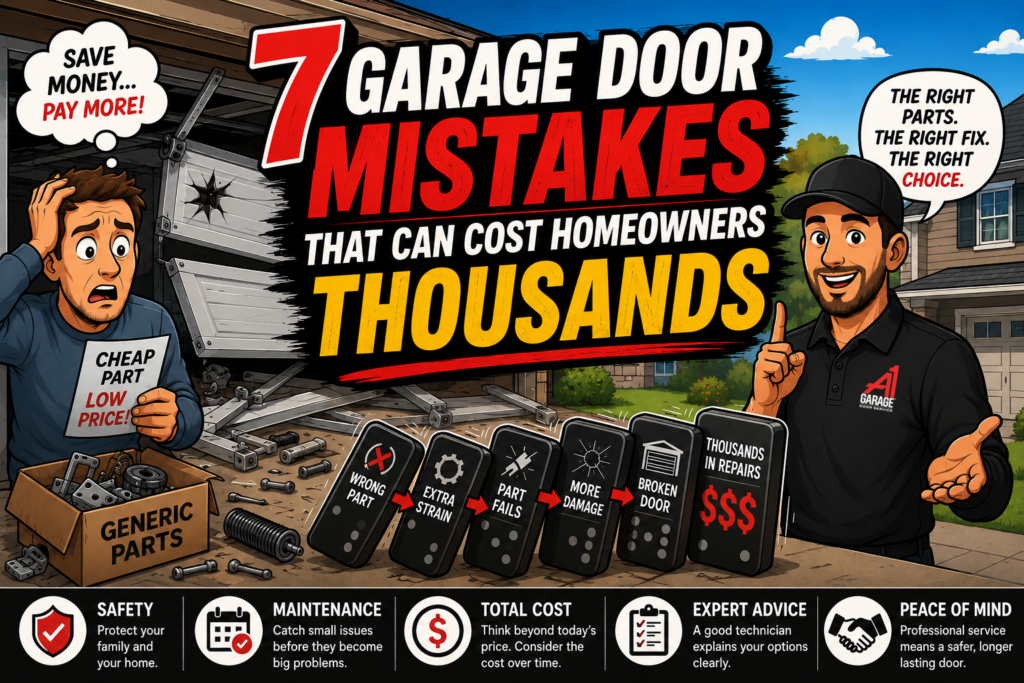
Before we get into the full article, here are the big answers.
- Cheap garage door parts can cost more later.
- Springs must match your exact door system.
- DIY spring repair can be dangerous.
- A working door does not mean a healthy door.
- Maintenance helps catch small issues early.
- One bad part can create a domino effect.
- A “Band-Aid fix” may cost more over time.
- A good technician should explain options clearly.
- Homeowners should ask about safety, lifespan, and total cost.
- Professional eyes matter because garage doors are heavy systems.
Have you ever started a home project and realized it was too much? Have you ever bought a cheap part online, then regretted it?
A1 Garage Door Service sees this unfortunate scenario often with garage door projects. A homeowner wants to save money. That makes sense. But with garage doors, the cheapest answer can also become the most expensive one.
Your garage door is one of the largest moving systems in your home. It has springs, cables, rollers, hinges, tracks, drums, and an opener. They all work together.
When one part is wrong, weak, or worn out, the whole system can suffer.
What Are the Biggest Garage Door Mistakes Homeowners Make?
The biggest garage door mistakes are buying the wrong parts, skipping maintenance, ignoring warning signs, and choosing price over total cost.
That does not mean homeowners are careless. Most people simply do not know how complex a garage door system is.
 A1 Pro Tip:
A1 Garage Door Service teaches homeowners to look beyond the first price. The real question is not always, “What does this cost today?” The better question is, “What will this cost if I wait?”
Mistake 1: Buying Garage Door Springs Online
Garage door springs are not one-size-fits-all.
A spring must match the door’s weight, height, track setup, drum type, and movement. A random spring from an online store may be close to the proper spring. But close is not good enough.
If the spring is wrong, the door may feel heavy. The opener may strain. Cables may come loose. The door may stop moving safely.
Springs also carry high tension. That makes DIY spring repair risky. DASMA recommends contacting a trained door systems technician when damage or wear is found on parts like springs, hinges, rollers, or panels.
Mistake 2: Choosing Cheap Hinges, Rollers, or Hardware
Some parts may look the same online. But they are not built the same.
A light-duty hinge may work on a small door. That does not mean it belongs on a heavy glass, wood, or insulated door.
The wrong hinge can bend. Fasteners can pull out. Rollers can leave the track. Then the door can crash.
An A1 True Customer Story From the Field
A1 Garage Door Service saw a large full-view glass garage door with the wrong hinges installed. The door was heavy and beautiful. But the hardware did not match the system.
The homeowner found cheaper hinges online. They cost less upfront, but they were too light for the door.
About a year later, the door failed. One roller popped out. Then the rest followed like dominoes. Hinges ripped out. Fasteners failed. Glass broke. The door ended up on the floor.
That repair became far more expensive than using the right parts first would have been.
The lesson is simple. Garage door parts must fit the door, not just the budget.
Mistake 3: Skipping Garage Door Maintenance
Many homeowners say of their garage door, “It still goes up and down.” That does not mean it is safe.
A garage door can work while parts are wearing out. Bearings can dry out. Rollers can grind. Springs can weaken. Cables can fray. The opener can hide problems because it keeps pulling the door.
A1 Garage Door Service compares this to a car. A car may run without maintenance for a while. But when something fails, other parts often fail too.
A1 Pro Tip:
The garage door industry recommends routine inspection and maintenance for doors and openers. The Door & Access Systems Manufacturers’ Association (DASMA) offers homeowner maintenance guidance for checking wear, lubrication needs, and safety systems.
Mistake 4: Thinking DIY Is Always Cheaper
Some DIY garage door work is fine.
You can look at the door. You can listen for strange sounds. You can test safety sensors. You can keep the area clean.
But springs, cables, drums, and major hardware are different. These parts can hurt you if handled incorrectly.
A good rule is this:
Look, listen, and report. Do not force, loosen, or remove high-tension parts.
A1 Pro Safety Tip:
Garage door openers also have federal safety standards. Residential automatic garage door operators made after January 1, 1993, must meet entrapment protection requirements.
Mistake 5: Shopping Only by Price
Price matters. Every homeowner has a budget.
But price and cost are not the same. Price is what you pay today. Cost is what the problem takes from you over time.
Cost can include:
- Another service visit
- Missed work
- A trapped car
- Damaged panels
- Broken glass
- A full door replacement
- Safety risks
A1 Pro Tip:
Sometimes a smaller repair today prevents a bigger repair later.
DIY vs. Professional Garage Door Repair
DIY may be okay for:
- Cleaning tracks
- Checking photo eyes
- Listening for noise
- Looking for loose hardware
- Light lubrication, if approved by your owner’s manual
Call a pro for:
- Broken springs
- Frayed cables
- Bent tracks
- Door off track
- Heavy door movement
- Loud popping sounds
- Cracked hinges
- Opener strain
- Door balance issues
A1 Pro Tip:
A professional can spot what most homeowners miss. That is the real value of hiring a pro instead of going the DIY route.
What Should a Good Garage Door Technician Explain?
A good technician should not just say, “Here is the price.”
They should explain:
- What failed
- Why it failed
- What happens if you wait
- What repair options exist
- What is urgent
- What can wait
- What improves safety
- What improves lifespan
A1 Pro Insight:
A1 Garage Door Service believes homeowners deserve options. That may include a basic fix, a middle option, and a long-term solution.
The right answer depends on the home, the door, and the homeowner’s plans.
Cost Factors Homeowners Should Understand
Garage door repair costs depend on many things, including:
- Door size
- Door weight
- Spring type
- Hardware grade
- Opener condition
- Track condition
- Labor needed
- Safety risks
- Whether parts failed together
Garage door replacement can also add value. In Zonda’s 38th annual 2024 Cost vs. Value report, garage door replacement had one of the highest national returns among remodeling projects.
In One Minute
- Do not buy random garage door springs online.
- Cheap parts can damage expensive doors.
- A working door can still be unsafe.
- Maintenance helps stop domino-effect failures.
- DIY is risky around springs and cables.
- Ask about total cost, not just today’s price.
- A good technician should educate you.
- A1 Garage Door Service recommends professional inspections for safety and peace of mind.
FAQs on Avoiding Garage Door Mistakes
Why are garage door springs so specific?
Springs must match the door’s weight, height, drums, and track setup. The wrong spring can make the door unsafe.
Is DIY garage door spring replacement safe?
No. Springs are under high tension. A1 Garage Door Service recommends calling a trained professional.
How often should I maintain my garage door?
Most homeowners should schedule maintenance at least once a year. High-use doors may need more frequent checks.
Why does my garage door still work if something is wrong?
The opener may be forcing the door to move. That can hide balance, spring, roller, or bearing problems.
Should I repair or replace my garage door?
It depends on the door’s age, damage, safety, and repair history. If repairs keep stacking up, replacement may be smarter.
Ready to Protect Your Garage Door Investment?
A garage door is too important to ignore and too expensive to replace unnecessarily. Let A1 Garage Door Service inspect your system, identify potential risks, and help you avoid costly surprises down the road.
Schedule your inspection with A1 today and get expert advice you can trust.
Want to learn more about this topic from the A1 experts? Watch A1’s podcast “The Garage Authority” below: