



Blog | GARAGE DOORS
When is a Jack Shaft Garage Door Opener the Right Choice?
Short on time? No problem. Here is the short version.
- A jack shaft garage door opener mounts on the wall beside the door.
- It is often the best choice for high-lift, vertical lift, and tall ceiling garages.
- It helps free up ceiling space for storage, lighting, or a cleaner look.
- It is not the best fit for every garage door setup.
- Some low headroom and zero-clearance doors can create safety, sealing, and cable issues.
- You need a proper outlet near the opener. An extension cord can void the warranty.
- A jack shaft opener is a premium product, so the install needs to be done right.
- At A1 Garage Door Service, we recommend jack shaft openers when the door system, track, and space truly support them.
Is a jack shaft garage door opener the right choice for your home?
And more importantly, how do you know if your garage setup can actually support one without experiencing problems later?
At A1 Garage Door Service, we like jack shaft openers for the right application. They look sleek. They save overhead space. They solve real problems. But they are not a one-size-fits-all answer.
In this guide, we will break down exactly when a jack shaft opener makes sense, when it does not, and what factors matter most before you install one.
By the end, you will know if this sleek, side-mounted opener is the right fit for your garage or if another option will save you time, money, and headaches.
What is a jack shaft garage door opener?
A jack shaft opener, also called a side mount or wall mount opener, installs beside the garage door instead of above it.
Rather than pulling the door with a rail and arm, it turns the torsion shaft directly. That means the opener lifts the door from the side.
 A1 Pro Insight:
For many homeowners, having a jack shaft opener creates a cleaner and more open garage ceiling.
Why homeowners like them
- Clean, modern look
- More overhead room
- Great for tall ceiling garages
- Good option for high-lift doors
- Better fit for garages with storage racks or specialty layouts
When is a jack shaft opener the best choice?
This is the most important question we get at A1 about side-mounted openers.
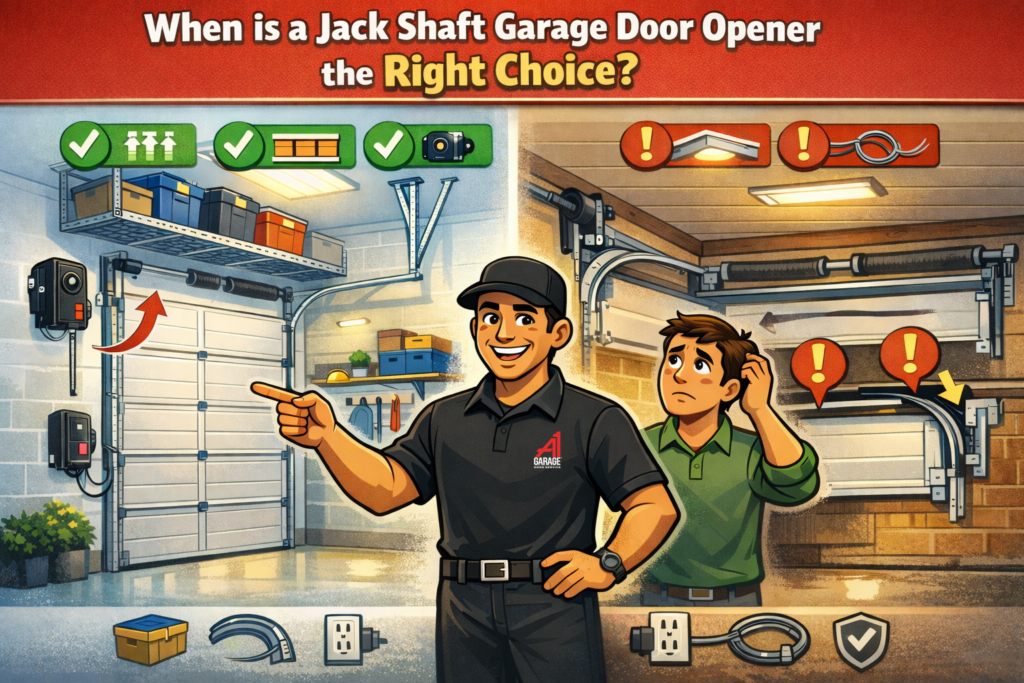
A jack shaft opener shines when the garage has a high-lift track, vertical lift track, or a very tall ceiling.
With those setups, a standard overhead opener can become awkward fast. The arm would need to be too long. The rail may interfere with door travel. The opener can end up pulling the door in an unnatural way.
A jack shaft opener solves that problem by working from the side.
Common ideal uses
High-lift garages
These doors travel up the wall longer before turning back.
Vertical lift doors
These doors go straight up and are common in shops and specialty garages.
Garages with tall ceilings
If your garage has 12-foot or 14-foot ceilings, a side mount opener often makes more sense.
Garages with ceiling storage
If you want to keep the ceiling open for racks, lighting, or a clean design, this can be a strong option.
When a jack shaft opener is not the best choice
This is where honesty matters.
Just because a jack shaft opener can be installed does not mean it should be.
At A1 Garage Door Service, we believe in doing what is right for the homeowner long term. That means saying no to a customer when we think a setup will create future problems.
Caution with low headroom and zero-clearance doors
Low headroom and zero-clearance systems can be tricky.
With some of these doors, the top section needs pressure to seal correctly when the door is closed. A traditional trolley opener helps apply that pressure. A jack shaft opener does not do that in the same way.
That can create problems like:
- Poor top seal
- Gaps at the top of the door
- More movement in the top section
- Security concerns if the top panel can be pushed in
- Extra wear from a setup the door was not designed for
There can also be cable tension issues on tighter radius track setups. In simple terms, the opener can create movement that makes the cable more likely to come loose if the setup is wrong.
A1 Pro Insight:
For these reasons, many professional companies treat certain low headroom applications as a hard stop for jack shaft openers.
Why track radius matters
Most homeowners never think about track radius, but it matters if they’re thinking about a jack shaft opener.
A larger radius, such as a 15-inch radius track, is usually a better fit. Tighter setups, like 12-inch radius or less, can create more challenges.
Why?
Because a standard opener keeps some pressure on the system differently. A jack shaft opener holds and drives the door from the side. On tighter track systems, that can create a bump or shift that increases the chance of cable trouble.
A1 Pro Insight:
The importance of understanding track radius is a big reason professional installation matters so much with jack shaft openers.
The biggest mistake homeowners make
The biggest mistake is choosing the opener based on looks alone.
Yes, jack shaft openers look great. But they are still a mechanical system. The best opener is the one that matches your door, track, space, and power setup.
When consulting on jack shaft openers, a good garage door company should explain:
- Whether your track supports one
- Whether your door seals correctly with one
- Whether the cable path stays safe
- Whether your garage has proper power nearby
- Whether the opener keeps its full warranty after install
A1 Pro Insight:
If a company says, “We can make it work,” that’s not a good sign. The better question is, will this opener work well for years?
Power requirements homeowners should know
A jack shaft opener needs a proper nearby outlet. Simply using an extension cord to reach an outlet that’s farther away can void the opener’s warranty.
That matters because this is a premium opener. You do not want to spend more money and then lose warranty protection over something avoidable.
A1 Pro Insight:
At A1 Garage Door Service, we want homeowners to protect their investment. If the outlet is not there yet, it is often better to have the right electrical work done than to rush a bad setup.
Are jack shaft openers reliable?
Yes, when they are installed in the right application.
Modern models have improved safety systems, including cable tension monitoring. That is important because these openers work differently from trolley systems.
Some brands feel smoother than others in operation. Some may have more noticeable motion during safety checks. Either way, the bigger point is this: proper setup matters more than marketing.
A1 Pro Insight:
A premium opener on a door it is not made for is the wrong opener.
Cost factors to think about
Jack shaft openers usually cost more than standard trolley openers.
The total cost can be affected by:
- Type of garage door
- Track setup
- Need for electrical work
- Locking accessories
- Door size and weight
- Whether the system needs changes to support the opener
Because of that, homeowners should look at total value, not just the opener’s price.
A1 Pro Insight:
A cheaper shortcut can cost more later if the install causes warranty, safety, or performance issues.
DIY vs. professional installation
Installing a jack shaft opener is not a good DIY project for most homeowners.
A jack shaft opener ties into the torsion system, door balance, cable tension, safety settings, and track behavior. Those are not small details. They are complicated and potentially dangerous parts of the garage door system.
A professional should confirm:
- The door is properly balanced
- The track layout is appropriate
- The shaft and coupler fit correctly
- The cable tension system is working
- The auto-lock and safety features are installed right
- The opener limits and force settings are correct
If the garage needs electrical work, that should also be done properly.
Our advice at A1 Garage Door Service
At A1, we like jack shaft openers a lot. In the right garage, they are one of the best opener options available today.
But we do not recommend them just because they are sleek or popular. We recommend them when the setup truly supports them.
That is how we protect homeowners. That is how we protect performance. And that is how we help a premium opener stay worth the investment.
In one minute
- Jack shaft openers mount on the wall beside the door.
- They are ideal for high-lift, vertical lift, and tall ceiling garages.
- They free up overhead space and create a clean look.
- They are not always right for low headroom or zero-clearance setups.
- Track radius, sealing, and cable tension all matter.
- A nearby outlet is required to protect the warranty.
- Professional installation is the safest and smartest choice.
FAQs on Jack Shaft Openers
What is a jack shaft garage door opener?
It is a wall-mounted opener that lifts the garage door by turning the torsion shaft from the side instead of pulling the door from overhead.
When is a jack shaft opener the best option?
It is often best for high-lift doors, vertical lift doors, tall ceiling garages, and garages that need open ceiling space.
Can a jack shaft opener work on any garage door?
No. Some low headroom and zero-clearance systems are not a good fit and may create sealing, cable, or safety issues.
Do jack shaft openers need a special outlet?
They need a proper outlet nearby. Using an extension cord can void the warranty.
Are jack shaft openers worth it?
Yes, in the right application. They can be a great long-term solution when matched to the correct door and track system.
Is a jack shaft opener the right fit for your garage?
At A1 Garage Door Service, we take the guesswork out of it. Our team will inspect your door, track, and space to give you a clear, honest recommendation—no pressure, just the right solution for your home.
Schedule your garage door inspection today and make sure your next opener is the right one for the long run.